 Emma Thompson
Author Archives: Emma Thompson
Hi, I'm Emma Thompson. Welcome to The Pet Town! I'm a Pet lovers like you and please feel free to get in touch with any questions. Enjoy your stay!
 Emma Thompson
Author Archives: Emma Thompson
Hi, I'm Emma Thompson. Welcome to The Pet Town! I'm a Pet lovers like you and please feel free to get in touch with any questions. Enjoy your stay!
In this article, you’ll learn more about natural grass and artificial grass to determine which of the two is better.
Do you want to enjoy a green lawn all year round where your pets and family members can use it freely? You have two options, going for natural grass or synthetic grass.
While natural grass provides a perfect play area for dogs, allowing them to dig and move around freely, pet owners end up needing to do major cleaning and maintenance every time. But there could be a solution to this problem, which is artificial grass for dogs & pets.
Artificial turf products feel and look like conventional grass that provides a durable, stain-resistant grassy surface, discouraging persistent diggers. Hence, you maintain the aesthetic appeal of your lawn while allowing your pups to do their own thing.

Dogs enjoy rolling in the grass to mask their scent, which is their instinct. In the wild, an antelope would likely bolt for safety if it smelled a wild dog’s scent. Prey animals, like antelopes, are less likely suspicious of frightened of grassy coated smell than another that has a wolf’s smell. Hence, the wild hunting dog gets closer to its prey.
The way dogs see the world relies on their sense of smell. A dog’s sense of smell is many times stronger than humans. Hence, they can distinguish each smell the same way humans distinguish each object visually. When someone is cooking, dogs break up smell separately, such as the scent of meat, peppers, tomatoes, and other spices.
Dogs spend most of the time sniffing things to distinguish components. Therefore, it’s not surprising why dogs roll and sniff around in the grass because it’s a way to satisfy their urge to distinguish various smells, which is their natural tool for survival. This experience is something that natural grass can generously provide.
That’s why synthetic grass manufacturers design their products to mimic the look and feel of natural grass as close as possible for dogs to love. They employ state-of-the-art equipment and techniques to provide the best features of artificial turf without so much functional and aesthetic difference with natural grass.
Most dogs enjoy the outdoors, and nibbling grass helps them fill the hours when they get bored alone. While eating grass isn’t generally harmful to dogs, doing so can cause internal parasites because of stools and animal droppings. In addition, pesticides and herbicides sprayed on the lawn can cause negative health effects on your dog.
Artificial grass products are designed with the health and safety of dogs in mind. They’re allergen-free and don’t have insecticides or fertilizers, unlike natural grass. As mentioned, the antimicrobial technology of artificial turf helps prevent odor and bacterial buildup. This technology is infused into the artificial grass’s backing during manufacturing that won’t fade or wear off over time.
Now, you don’t have to worry about your pets or children getting exposed to germs and harmful chemicals, keeping everyone safe and healthy.
Your outdoor living space provides a great environment for your pets and family to bond. While natural grass, in every essence, is a great view and area for your furry friends to play around and with everyone to spend time enjoying the view of the garden and the sky above, maintaining a lawn can be tedious and expensive, requiring watering and mowing.
Artificial turf helps the environment because it eliminates the need to use pesticides, fertilizers, weed whackers, and lawnmowers. You can reduce your carbon footprint and conserve water by installing artificial pet turf.
Synthetic grass is an environmentally friendly landscaping solution available nowadays. They have antimicrobial properties, promoting a better smelling, safer, and cleaner environment for your pets and your family.
Creating the perfect lawn from scratch can take time using natural grass. If you need a grassy space for your pup, a quick and easy solution is using artificial grass. Installation time differs on the size of the artificial turf, amount of base, objects to work around, and ground removal.
Artificial turf installation is specially designed for dogs. When you choose the right artificial turf product and supplier, you can expect excellent services from experienced installers. The installers will ensure a great drainage system that allows pet urine and rainwater to pass through the artificial turf. In this way, the fast and easy installation would mean your dog can enjoy a green lawn as soon as possible maintenance- and stress-free.
Artificial grass is maintenance-free. The dual-flow backing knitted to artificial turf allows optimal drainage. The drainage system of artificial grass provides edge-to-edge drainage to prevent flooding. Urine, water, and other liquids flow through the sand, turf backing, and base. You can remove solid waste like you normally do on a natural grass lawn.
Therefore, you won’t need to deal with trapped odors or muddy spots. So, your dog and lawn stay clean. Cleaning artificial grass only requires water-soluble cleaning products and a hose. You can pick up solid waste, spray any cleaner, and wash it off with your water hose.
When cleaning pet urine, you can spray the turf using a water hose at least once a week. You can spray the synthetic grass with equal parts of water and vinegar solution and rinse it off with water if you notice odor buildup.
The comparison of natural grass versus artificial grass has been explained. Now, it’s time to make a final decision as to what type of grass is suitable for your dogs. Natural grass is always a great option if you have all the time in the world to clean and maintain it.
A great alternative solution to natural grass is artificial grass, which provides plenty of benefits. You’ll have peace of mind that your dog stays safe and healthy when playing outdoors while maintaining the aesthetic appeal and cleanliness of your home.
Owning fish is almost like a full-time job itself, and as your aquarium or as many fish keepers say, “community” grows, so will your responsibilities. You cannot simply neglect your fish nor clean your tank; otherwise, there will be unfortunate consequences for the life forms that you are looking after.
Being an aquarium owner is an incredibly rewarding hobby; you can see the fish and other life you look after grow and flourish thanks to your hard work and dedication. There is so much to learn about this awesome hobby, and in this guide, we will simply be running through aquarium basics for beginners. However, if you are interested in learning much more detailed information, fishkeeping tips, and fish guides, you will want to visit www.LionfishLair.com.
This is an extremely common question amongst beginner fish tank owners. Fortunately, it has a fairly easy explanation. The best place for your fish tank to reside in your house or apartment would be a quiet, less busy area, preferably away from direct sunlight and heat.
This is simply because your fish (especially when first acquired) will be a little distressed and surrounding them with loud noises and busy movement is not fair on them. This advice still applies to your fish once they are settled in.
Also, the less natural sunlight, the better. Most fish species come from various places around the world and are used to different lighting, so often, you will have to replicate that in your tank – natural sunlight coming in will almost certainly cause more harm than good.
The equipment your aquarium needs is reliant on your fish and their requirements; however, most people starting out in the hobby (beginners) will be experimenting with freshwater fish, typically Goldfish. So, here is what you would need in a freshwater tank:

So, that is the basic equipment you will need for your freshwater fish tank. However, some people that start out want saltwater fish in their beginner fish tank, so here are the equipment requirements for a saltwater tank:
Once you have got your new tank and established some of the aquarium basics, you will need to familiarize yourself with the process of water care. You should always add a solution to any water before you put it in your tank. Tetra AquaSafe Solution helps neutralize or eliminate chlorine, chloramine, and heavy metals from your aquarium water. If your first tank is a small one, it is recommended to use spring water as it doesn’t contain any harmful chemicals.
You must change 10% of your aquarium water every week at the very least, or 25% every two weeks. The water you are replacing your tank water with must be the exact same temperature. Make sure to treat tap water with a water conditioner to neutralize any chlorine and ammonia before adding it to the aquarium. You should always change your filter cartridges at least once per month.
Selecting the right fish for your first tank is always a tough call, sure you could play it safe and go for a Common Goldfish or perhaps one of the Rasbora species, but you might not like the look or personality of either of those fish types.
The biggest recommendation when it comes to purchasing fish to occupy your aquarium is getting the most compatible ones. You do not want to purchase two fish types that are not compatible and will spend the whole time fighting. It is strongly recommended to do your research before purchasing any two types of fish, or even multiples of one species.
Nothing is better than setting up your first aquarium, choosing the best fish for it that are also compatible with one another, and then filling it with awesome accessories and decorations!

Some of the best decorations are simply funky aquarium boxes and caves for your fish to hide in, some people even go as far as to recreate Bikini Bottom from SpongeBob!
Some other good accessories would be colored gravel, ornaments like a volcano, underwater LED lights to give some different color to your tank, and an awesome mixture of aquarium plants.
Beginning your journey into becoming a fish tank and aquarium owner is somewhat daunting, although, if you follow this aquarium guide, running you through all the aquarium basics you need to know, you should be fine and will soon become an expert, expanding your community and aquarium life in no time!

First of all, you want to make sure that you are giving your dog a probiotic before introducing them to a new diet. This is going to help their stomach break down all of the new food and digest it properly. It can make them feel a lot better since it is not easy for canines to suddenly eat new foods. This can lead to diarrhoea, gas and vomiting. For example, PeakPets sell a fantastic probiotic. This is going to help your furry friend get the most from their new diet and so that they do not feel unwell in the process. You can feed this supplement with food and it should make a big difference for your furry friend

One of the main reasons why people change their dog’s diet is because the food they are currently eating is not agreeing with them. It might be causing gas, discomfort and vomiting. It can also cause diarrhoea or constipation. Try to figure out what in the food is doing this to your canine. This is going to allow you to find another diet that is going to be better for your pup’s needs. For example, a veterinarian might be able to help you with an elimination diet to see what is causing the sensitive for your furry friend. This way, you can make sure that it is not included in the next diet. After all, you want your dog to feel good!

You should always do your research when it comes to your dog’s diet. After all, you want to make sure that you are giving them nutritious food that is going to deliver all of the goodness they need to be happy and healthy. Therefore, spend a good amount of time researching what food is going to suit your dog, as well as your lifestyle. For some people, this might be kibble. For others, they will be interested in starting a raw diet. Either way, understand if you are giving your dog everything they need. Purchase this food in advance and read the instructions when it comes to serving sizes and how much to feed your pooch.
The biggest mistake that pet owners make when they want to introduce a new food to a dog is simply switching all of their food. In this way, canines are not like humans. While we can eat whatever food we want, dogs have sensitive stomachs. You simply cannot just give them different food. This is going to lead to bloating, nausea and toilet troubles. Instead, you have to make sure that you introduce the food slowly. For example, keep them on their current food and offer small pieces of the new one. This is going to allow them to get adjusted to it. You can do this over at least a week, steadily increasing how much of it they eat. Before you know it, they are going to have switched foods and there should be no side effects to their new diet.
If you want to move your canine to a new diet, you need to remember that they have a sensitive stomach. In particular, you need to show caution when you are wanting to switch their food. In order to make sure your furry friend does not feel unwell, start by giving them an antibiotic. This is going to help them get the nutrition they need from their new diet and avoid unpleasant side effects. In addition, make sure that you understand your dog’s needs and research the diet before switching. This is going to ensure it is the right decision for your pooch. With a new diet, always make sure that you start slowly. Gradually introduce the food over time.
Here are parasites you may encounter if you’re not careful as well as a few simple yet effective ways you can steer clear of them:
Lice are tiny insects that feed on human and animal blood. They spread by crawling from one person or animal to another. There are three common types of lice: body lice, head lice, and pubic lice. Of the three, head lice are disease-causing, while the other two will just suck your blood and cause uncomfortable itching.
As suggested by their names, head lice normally target the head, while body lice roam around your body. And yes, pubic lice target the pubic areas. Since human lice are different from dog and cat lice, being in close contact with a person infested with lice could lead you to catch them. However, you can’t get lice from your pets and vice versa.
The easiest way to prevent lice is by practicing good hygiene. Using shampoos and other over-the-counter medicines could also help reduce the biting and itching. If you own pets, you have to keep them clean to avoid lice attacks. Other ways of preventing lice are as follows:

Fleas are common parasites that feed on blood. Like lice, they’re common on animals like cats and dogs. The fur in animals provides the perfect habitat for fleas, but they can also be a nuisance to humans. Unlike lice that only crawl, fleas can spring from one victim to another. They say lice can only live for one day without a host, but fleas can go up to 100 days.
The most common flea species in America is said to be the cat flea. Although they normally attack cats, they could affect humans too. Their bites on humans usually leave red, itchy spots that are clustered in threes. The bites may also cause hives, rash, or swelling around the bite area.
To prevent fleas from infecting you, you could try the following:
Bedbugs are small, flat insects that love to live with people and pets. They find furniture, mattresses, and wallpaper cozy as hiding and nesting spots. These repulsive parasites typically come out and feed while you’re asleep at night. They feast on human and animal blood.
Bedbugs normally don’t cause or carry disease, but they can lead to unpleasant irritations like itchiness and allergic reactions when they bite.
These are a few easy ways to prevent bedbugs:
Scabies is caused by a mite that bites and lays eggs into your skin. The scabies parasite is transmitted through skin contact with an infected person. It commonly causes itching at night, crusty patches on the skin, rash, and skin sores. Scabies can be treated with scabicide, a prescription medication.
Scabies is said to also be a result of poor personal hygiene, so the best way to avoid it is by practicing cleanliness. You can try these tips as well:
These are parasites found in pigs and people. If you eat raw or undercooked pork, you risk ingesting this pesky parasite. Pork tapeworms are said to mainly infect the intestines and the brain. They normally lay eggs that can be transmitted to others through feces and or ingestion of uncooked meat.
Tapeworms can feed on the food you eat, thereby stealing some of the nutrients you’re meant to benefit from it. These parasites can also cause massive headaches and seizures when they infect the brain. They can be treated through medication in some cases, but your body usually resolves the infestation on its own. In worst-case scenarios, surgery might be required to get rid of them.
The best way to prevent pork tapeworms is by cooking or freezing meat to kill the parasite’s eggs. Here are a few tips on keeping safe:
Roundworms are small parasites that like to live in the digestive system of humans and animals. They thrive in areas with poor hygiene and sanitation. There are many different types of roundworms, but the common ones that infect humans are pinworms and ascariasis.
Roundworms can be harmful, causing problems like fever and diarrhea. They require a body to live in so they can mature into egg-laying adults. When they lay eggs in your body, the eggs are said to live in the stool, so when you poop, the eggs can end up in the soil, where they pose a risk of infecting other people or animals.
Although there are many types of roundworms, you can prevent them by doing the following:
Parasites are organisms that cause many different problems for their hosts, including discomfort and diseases. As mentioned, the best way to prevent parasitic infection is by practicing good personal hygiene. If you have pets around the house, see to it that they’re always clean and well groomed. Use things like DEWELPRO and other similar products to keep parasites at bay.
There are a number of things to keep in mind when setting up their enclosure; one of the most important being the space required. The general rule to follow is to have at least a 30-gallon leopard gecko tank. If you cannot provide this space, then a leopard gecko might not be right for you.
You will want your leopard gecko to be happy and safe, and you can achieve this by doing your research. There are plenty of factors that can make your leopard gecko live a healthy life, some of which can be read below.
Leopard geckos are terrestrial so they need to be able to absorb heat from the ground and the air. Substrates like newspaper and paper towels are not suitable options for this.
The main questions you should ask when buying substrate are:
One choice is a substrate like repti-carpet. This substrate can be easily cleaned (you can even throw it in the washing machine) and it is soft enough for the geckos to dig and create burrows. However, if you are looking for a substrate that mimics a leopard gecko’s natural habitat, you should research your options and even ask on reptile forums.
There are many different things that can be used to make a hide for the gecko. A hide is a place where they can go to feel safe. A hide can be as simple as a plastic container with an entrance hole cut into it. For example, a small plastic deli container with a hole cut into the side is ideal. More natural hiding spots are also available; it might be beneficial if you familiarised yourself with the term “bioactive”, if a more natural enclosure is what you would prefer.
Leopard geckos are nocturnal, so they will be most active at night, but some can be shy by nature. When first introduced to their new environment, they might need a little time to warm up to their owners before they will come out of their hide. By providing hiding spots, this allows them to have their own space.
Leopard geckos need a hot spot for basking. A heat lamp can be placed above the enclosure at one end, which will allow the other end to be cooler. This allows thermal variation, as the hotter end should be between 28 to 30 Celsius and the cooler end 24 to 26 Celsius. You can also use a heat mat placed under the enclosure, if it is glass; these are best used during the night, however.
Leopard geckos also need to be exposed to UV light, as this helps them to produce vitamin D3. This vitamin is essential for their bone development.
Leopard geckos are omnivores. Their diet should consist of a good quality reptile food and a number of insects. They are not picky eaters so a number of different types of insects can be fed to them. To help with this, a number of feeder insects can be purchased.
The best way to provide the right type of food is to use a self-feeding dish. This can be made by using a shallow, wide bowl. A piece of slate can be used to hold the food in place so the gecko has to work for its food. This will help to ensure that they are getting all of the nutrients they need.
Another important thing that a leopard gecko enclosure needs is a good source of water. The best way to provide this is to use a water dish without a lot of surface area. This will allow the gecko the ability to drink without getting water on the rest of their body.
By making sure that the enclosure has everything a leopard gecko needs, they can live a healthy and happy life. That’s the best way to make sure that you get the most out of owning a leopard gecko.
While some breeds demand more baths compared to others. Bathing your puppy often can strip natural oils from the coat, drying the skin. Unless your puppy is a show dog or has fleas, they shouldn’t need a bath more than four times in one year.
Puppies must not be bathed until they are around four to eight weeks old. The little fellows have trouble regulating their body temperature at that tender age, so it can get chilly for them. Puppies that have diarrhea may need a dip, but that alone is enough to stress the puppy, making the condition worse. They could even end up with pneumonia if you don’t exercise caution.
In this article, we will share the best tips and tricks to give your puppy the best bath ever. Take note.
If your puppy has a poodle-like coat more bath time is needed. To save you time, rather plan to bathe your pup around the time they get their coat trimmed. Get them a trim at least every two months.
Wiry and silky coats on the other hand are good to go with four baths a year. Breeds that are double-coated like German Shepherds need more than 4 baths a year. To get the best out of your bath time with your puppy aim for fall and spring after their normal shed.
Rottweilers for example may only need a bath only once per year because they are smooth coated. But of course, if duty calls you must perform “the bath.” If they get smelly for whatever reason, like Dachshunds can get a bit pungent and can call for quick intervention when needed.
As mentioned before, dogs with smooth coats dry very quickly. So in as much as they hate baths they usually love the towering phase, simply because this is the opportunity to steal the towel and play much-loved puppy games like tiger war. Giving your dog the best bath ever doesn’t have to be so hard. The more you present the best possible experience, the less your dog will dread bathing. So take note!
Each and every human invention that resulted in a commercial product is meant to solve a specific problem. For example, since the concept of walking dogs was widely being practiced and accepted, more and more pet products were emerged to address the problems revolving around ‘dog walking’ and make it a comfortable experience.
In the same way, retractable leashes entered the market to provide a better dog walking experience (more about it later in this article). The controversy started when gruesome accidents happened to dogs and even their owners because of using retractable leashes.
Unlike other types of leash, collars, harnesses, and pet products, retractable leashes are potentially dangerous to use. However, that doesn’t mean you should not use retractable leashes at all.
Also, this means you should get a retractable dog leash of high quality. When you get a cheaper dog leash, you’re actually compromising on your safety.
Of course, you’ll have to follow and keep in mind all the directions and safety measures it comes with. For example, if you have a chainsaw, you can injure yourself if you don’t practice safety measures.
Conclusively, retractable leashes are potentially dangerous to use but it also has a purpose which can make walking your dog easier and will provide more freedom to your beloved canine buddy. On the other hand, frequent accidents happen due to not following safety measures and instructions, using it for a different purpose, and poor handling.
Considering that, there are polar opposite opinions people have for retractable leashes.
A retractable leash is a type of leash that allows dog walkers to let their dog roam in wider proximity. This way, dogs get more freedom while walking. The leash is attached to a spring mechanism residing in a plastic structure that keeps the leash under tension and elongates when a dog moves to a wider radius of proximity.
This type of leash has a brake mechanism that enables locking the leash as per your wish, basically, you can decide how long the leash will be, thereby limiting the dog’s roaming range.
And when you feel your dog should be by your side, you can press a button to reel in and shorten the leash.
It’s a clear ‘No’ for new pet parents and untrained dogs. Why? Dogs who haven’t been trained or don’t even follow any simple commands like ‘stay’ or ‘down’ won’t listen to your commands when needed.
Consider retractable leash walking as an advanced level of leash walking. That said, If you’re struggling to leash walk your dog with confidence, you should not get a retractable leash. If your dog misbehaves and decides to escape from the spot, there are chances of getting yourself and your dog injured and losing him as well.
Cats too can walk on retractable leashes. However, you should see whether your cat wants to walk on a leash and a harness or not and learn how to walk a cat.
I’d like to stress the phrase ‘trained dogs’ because retractable leases are safe only for well-behaved dogs who will listen to you every time. Most accidents happen when your dog decides to chase the squirrel at the park and doesn’t get your recall through the leash or voice.
If you accidentally try to grab the unwinding leash with your hands, you can get severe burns and cuts. A retractable leash should only be controlled with the handle it comes with. Also, your dog can injure himself if he accidentally gets his legs tangled with the leash.
The problem intensifies when you start rewinding the leash or lock it suddenly when your dog is running in the opposite direction. A sudden jerk may cause injuries to the dog’s neck and trachea.
If you compare walking on a retractable dog leash with walking off-leash, you will be able to understand the issues in a better way. Dogs who can walk off-leash will always stay in your proximity and never take off after a squirrel or a rabbit.
If your dog can walk off-leash, he would be more alert, disciplined, and will be able to communicate with you efficiently. This will not only make the walking experience safe but also enjoyable with more freedom.
Your energy and emotions pass through the leash. Your dog receives the signals you give through the leash. In order to teach your dog when to fall back to the safe zone, you will have to train your dog for that.
Take your puppy to an empty backyard or a park and attach a retractable leash. Walk your puppy around for a while without giving any commands. Now, when a dog is away from you, bend down a bit, start rewinding the leash and show the treat. Rewinding the leash and showing him the treat should happen simultaneously.
When the pooch gets back to you, use your clicker to click and offer the treat. You have to practice this command along with ‘sit’, ‘stay’, and recall commands. When you’ve mastered this technique, your dog will understand the leash signals you give him. In other words, your dog will return to you when they experience the pull force of the winding leash.
Untrained dogs, I repeat, untrained dogs, should not be walked on a retractable leash. I hope what we have discussed in the article has given you a different outlook on a retractable dog leash. Sure, it is dangerous and can cause severe injuries including amputations of fingers! Never let children walk a dog on a retractable leash and follow all the instructions carefully before using it. If you have any questions or want to share with us your experience, do let us know about it in the comment section below.
Although no one ever likes the idea of having to leave their beloved dog behind, there are many times when your furry companion needs alternative accommodation. If you’re newly trying to navigate the best option for your dog, trying to understand similar-sounding services can be confusing. Although a boarding kennel and dog hotel may sound similar on the surface, there are a few key differences to understand.
A boarding kennel is a licensed and regulated facility that offers to house, feed, and exercise your pup while you’re on vacation. Typically speaking, a boarding kennel is a mass space of fenced-off areas for individual dogs. On average, the walls are manufactured with fencing or gates, as opposed to physical barriers. However, these fences do not go to the ceiling, enabling dogs to climb over the top of the structures. In addition, as these facilities are typically large areas, natural lighting may come from windows placed along with the ceiling, limiting natural light.
When booking such boarding kennels, many locations will base their fees on a set cost per size of the dog (in turn, establishing the rate by the size of the area needed to keep your dog).
In addition, many boarding facilities may have limited amenities like trails, water play, or outdoor play spaces. Therefore, it’s always important to ask any boarding kennel about these activities before booking to determine if the run attached to the kennel is the only outdoor activity they will have during their stay.
As kennels will typically have limited amenities or options for pet owners, the cost associated will often remain a flat rate, with strict routines and schedules for all boarded dogs. This environment is ideal for dogs that are not easily stimulated and enjoy predictable routines.
A dog hotel is also a licensed and regulated facility that provides care for your dog while you’re away. Unlike the large, fenced-in kennel, dog hotels will typically offer small rooms (with doors) for all dogs. These rooms are built to mimic household environments, complete with drywall, windows, and flooring. Additionally, pet hotels may have small household items, like a bed, chair, or similar items, within the room. These rooms are ideal for dogs who become easily stimulated (which can be common with kenneled dogs), giving them a private, quiet area to relax. As a result, dogs can settle more readily. Dog hotels are also more likely to provide controlled climate environments, heating, and air conditioning to each room.
Dog hotels will often cater to a wide array of needs, from well-loved trails to agility equipment when it comes to amenities. Many will offer water features or outdoor play areas built for communal time with the boarded dogs. Dogs are naturally social pack animals and will often enjoy the time with other canines. With different features often comes a different price point for many owners. There’s always room for customization from extra playtime to additional walks on the property, hand-made treats, and high-end meals.
Whether you want to find a dog hotel to spoil your dog while you’re gone, or you’re looking for the most cost-efficient method of boarding, starting with a referral is the easiest. Online websites will provide a list of many different services in your area to choose from, regardless of your budget. Always make sure that you contact the business prior to booking to confirm the services required and the final costs. Inquire about their housing style, heating or cooling systems, and whether the kennels (or rooms) are built out of solid material.
If your dog is easily distracted by other dogs, people, or noises, it may struggle in a standard dog kennel environment. For those needing a bit less stimulation, a dog hotel may be the better option. Dogs with dietary issues (like allergies or raw food) needing assistance may also struggle with standard boarding kennel environments. Dog hotels often have private kitchens on-site which can safely store food, medications, or refrigerated items.It’s essential to find the right balance of services, amenities, and budget for you and your dog. Doing that needs to start with understanding the differences between the two popular boarding options for your pup.

When riding a horse, you want to make sure that you are as comfortable as possible. Therefore, taking the time to find the right saddle for you is hugely important. By taking the time to try several saddles to find one that works for you, you can then ensure your as comfortable as possible regardless of the length of the ride that you will be heading out on.

In addition to the perfect saddle, it is important to make sure that you do not forget about the turn out rugs and blankets. These will be crucial in the cooler months as this will enable you to make sure that your home is as warm as possible. With many different levels of thickness as well as shapes and sizes, these are important to ensuring that your horse stays warm throughout the winter. Though this is an additional expense, spending the money on high-quality equipment will benefit you overtime when it comes to ensuring their overall health when outside.

In addition to rugs and blankets for the winter months, it is important to make sure that you are prepared for the summer. By making sure that you have fly masks in place for when spending long hours out on the field or on a ride, this is a simple yet effective way of making sure your horse remains comfortable. These masks will prevent the flies from getting into their eyes and bothering their eyes. These fly masks are made of a light mesh to ensure that they are comfortable, allowing them to be worn on even the longest ride.

In addition to the perfect saddle, you want to make sure that you as the rider are as safe as possible. Therefore, taking the time to find the perfect riding hat is important. When choosing a riding hat you want to make sure that it is not only completely comfortable but also is the perfect colour scheme for you.

The final element that you need to consider when looking to purchase horse accessories is the tack cleaning kit. With all your tack travelling around with you and getting grubby over time, you need to ensure that you are prepared. Therefore, having a tack cleaning kit on hand at all times will enable you to ensure you have all your tack on hand at all times.
Regardless of whether you are a new horse owner or you are an experienced horse owner looking to improve their overall experience, these accessories are sure to help you. Which of these will you be using?
Once upon a time, someone would just refer to their canine companion as a pet dog. Today, however, it’s no longer enough to simply call them that anymore. You’d hear someone say, “This is my poodle, Lux” or “I have a golden retriever named Tucker.”
As you can see, people tend to put more emphasis on the dog breed nowadays. The tricky part is that it takes some extra effort to become familiar with the many canine breeds, with some breeds looking so alike that you might not be able to tell the difference.
One example is the American Staffordshire terrier versus the pit bull terrier. One quick look, and you’ll conclude that they’re the same breed. But are they really the same breed? Read on to learn how different the two breeds are.
One of the reasons why Staffies and pit bulls share so many similarities is because of their same bloodline.
During the late 1700s, the Brits crossbred black and tan terriers and bulldogs, which resulted in the Staffordshire bull terriers. Now, in the 19th century, the Brits once again bred Old English terriers with Old English bulldogs to create a breed with the gameness of terriers and the athletic build and power of bulldogs. This birthed the breed called “bull and terrier.”
Now, immigrants brought the bull and terrier to America and once again tried selective breeding to increase their height and making them leaner. These were later on called the American pit bull terriers.
The bull and terrier breeds also became the ancestors of Staffies and bull terriers. In conclusion, yes, Staffies and pit bulls are related to the bulldog as their grandfather. But their similarities don’t stop there.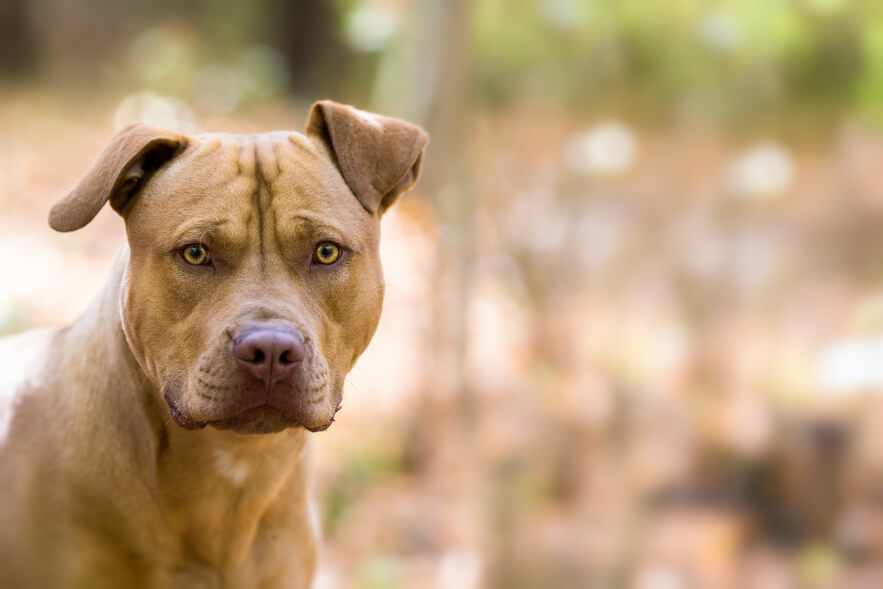
Staffies and pit bulls were once bred for dogfighting. Fortunately, people started becoming more aware of the brutality of the so-called sport, which was essentially condemned by the United Kennel Club (UKC). The sad thing is that the reputation of the pit bulls never recovered and is still associated with dogfighting to this day.
As a result, the American Kennel Club (AKC) chose not to recognize the American pit bull terrier as a dog breed. The Staffordshire bull terrier, however, was accepted. In addition, since the original name of Staffies was too similar to its cousin, its name was changed to American Staffordshire terrier.
As you can see, the name changes and politics and registration rules among kennel clubs are responsible for most of the confusion between these two breeds.
Staffies and pit bulls are both muscular canines and considered to be medium-sized dogs. Staffies are shorter, measuring 17–19 inches in height, measured from shoulder to paw. Meanwhile, the pit bull stands at 17–21 inches in height. In addition, Staffies are a lot heavier, weighing on average of 40–70 pounds, whereas pit bulls only weigh around 30 – 65 pounds. Staffies are stockier and shorter, whereas pit bulls are more slender and taller.
Both Staffies and pit bulls are well-balanced dogs, with large, square heads and muzzles. However, Staffies tend to have more defined muscles that give them a powerful appearance.
In terms of head size, however, the difference becomes more evident. The UKC standards state that both Staffies and pit bulls have straight, broad, tapering muzzles. Pit bulls feature a flat, medium-length head that’s widest at its ears with a long muzzle that has a 2:3 ratio in relation to the length of their head.
Staffies, on the other hand, are known to have a short head with a broad skull, pronounced cheek muscles, and a short muzzle. There are no regulations for the length of the muzzle; however, it should be shorter or longer than the 2:3 ratio given to the pit bulls.
In terms of their coat, both Staffies and pit bulls have smooth and short coats. Both breeds are born in various colors. In general, though, kennel clubs won’t accept tan and black, red, fawn, or brindle in Staffies as well as white that covers 80% or more of its body. Pit bulls are accepted in any color, except merle. Also, the blue nose variant is the rarest color, followed by the red nose.
On to the most commonly asked question, “Are they vicious and scary?” That’s a hard no! Both Staffies and pit bulls are not inherently aggressive breeds, as you imagine them in brutal dogfights with all the blood and sharp canines.
In reality, pit bulls and Staffies are no more vicious than Chihuahuas. It’s entirely dependent on their owners and their upbringing. So if the owner trains these breeds to be dangerous and vicious, that’s how they’ll grow to be. But raised in a playful and loving home, they can make some of the most affectionate and friendliest pets. With that said, the AKC and UKC do provide a guide on the temperament traits for Staffies and pit bulls.
Staffies are intelligent, tenacious, courageous, trustworthy, loving, and affectionate to their family. They’re much more good-tempered than pit bulls. Pit bulls are considered confident, strong, zesty, and always eager to please their owners. So without proper training and attention, pit bulls can live up to their bad reputations. Most workers in animal shelters often said that pit bulls are much volatile than the Staffies.
Still, both breeds are considered very loving toward their family and people but require effective socialization and training in their early lives.
So back to the main question, are Staffies and pit bulls the same? It’s a yes and no. Some people consider them to be the same breed, who were given their different names because of their not-so-good history.
The mainstream answer for that question is no. Although they have the same bloodline and are quite similar, there’s actually a range of inconspicuous dissimilarities between them—Staffies are chunkier while pit bulls are more athletic— proving that they’re indeed different from each other. Think of them as cousins instead of siblings. Even kennel clubs recognize the Staffie and pit bull as two separate dog breeds.
Regardless of their differences, both breeds are affectionate family dogs that’ll give you lots of cuddles and licks and definitely don’t deserve the unfair stigma that came from their bloody history.