slot88

Archive

Category Archives for "Fish"

Koi Fish History Explained and Meaning

Found in both Chinese and Japanese culture, koi fish is one of the most significant symbols. They are the favorites of pond and aquarium enthusiasts worldwide. Also, they have a strong symbolic meaning and rich history.

Koi fish is common in Feng Shui and depicted on the artwork, tattoos, and clothing. By understanding the koi history and meaning you can know why people adore this beautiful fish so deeply.

Koi fish history

Vibrant, graceful, and one of the most popular fish in the world, the koi is a legendary fish. The koi are native to Asia and Central Europe where people bred them for centuries for food. Koi is water-tolerant and hard.

This is the reason why they were the best option for breeding. Several records of koi being used by people as a food date back to the 5th century BC in China. Eventually, it spread throughout Asia including Japan.

Often koi is associated with Japan, but it originated in China. And, they were introduced by the Chinese invaders. While the fish got their name about 500 BC, koi has been around for a long time.

Even fossils of koi date back to 20 million years ago. The genetic mutation that happened naturally brought these wonderful color patterns in koi that you see today.

The hardiness of the koi fish made it favorable for the people living in cold areas to breed. As such, it became a favorite fish for the people. They were bred for food.

Koi has an excellent oily fat content and it was the perfect supplement for the natives of the Honshu Island. They ate a heavy rice diet with koi fish. The rice farmers used to breed koi on the ponds close to their paddy field.

You may also like:  Koi fish for sale.

The koi fish legend

An ancient tale narrates about a shoal of koi swimming upstream on the Yellow River. The main goal for each of them was to make their way through the water current and reach the waterfall that was invaded by the demons.

Gaining strength by going against the current, they swam through the river. After they reached the waterfall, most koi turned back. A few remaining koi made strong efforts and refused to give up.

They tried and tried but to no avail. The local demons caught hold of their attempts and mocked them. They even heightened the waterfall. After hundred years of constant leaping, one koi made it to the top of the waterfall.

Because of the determination and perseverance of the koi, the Gods turned it into a golden dragon. Dragons symbolize strength and power.

Koi fish meaning

Koi fish is a legendary fish. Many attributes of the fish symbolize important lessons and trials an individual encounters in life. It has an energetic and powerful life force.

And, demonstrated by its power to swim against water currents, even upstream. Here are some of the characteristics associated with koi fish.

  • Prosperity
  • Success
  • Longevity
  • Good fortune
  • Ambition
  • Courage
  • Perseverance

Koi fish represent positive imagery. They are considered symbols of perseverance and strength because of their strong determination to go upstream. The koi fish symbolizes bravery by swimming upstream.

So, they are often associated with the Samurai Warriors of Japan. The high sense and integrity of the fish make them a popular choice for tattoos both in the US and Asia.

What is the meaning of koi?

The Japanese name for carp is called koi. The word koi describes the adorned, bright-colored fish and the muted colors that you find on the classic carp. When the word is used in Japanese, it refers to both the colorful aquaculture carp and wild carp.

In Japanese culture, the word koi represents care and love. And, they are associated with love and friendship.

What does the koi fish color mean?

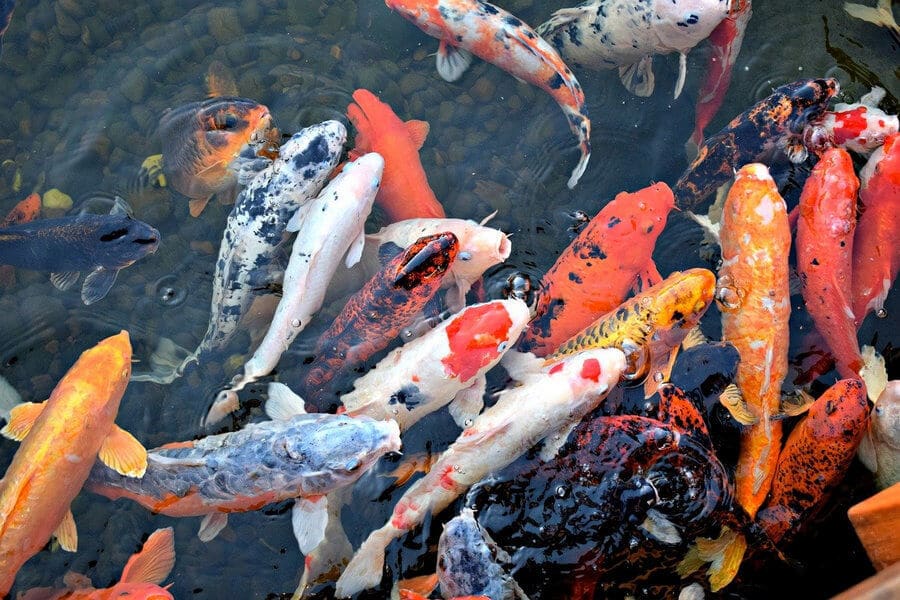
Koi fish are symbolized depending on their colors. Certain colors on their body denote certain aspects and outcomes in one’s life. The Kohaku Koi has a white body with red spots. And, it symbolizes achievement or success in a career.

The Kumonryu koi has two different variants. In one variation you get a white body koi with black spots. And, the other variation consists of a full black body. The Kumonryu koi represents life changes and the transitions that follow.

The Ogon is a silver-colored koi that denotes wealth and success in business. The Kuchibeni koi has white and red patches all over the body. Also, they are often called the ‘lipstick’ fish. That’s because of the red coloring around the mouth.

It appears that the fish has lipstick around its mouth. The Kuchibeni koi represent a long-lasting relationship and deep love. The Yamabuki koi is golden in color and represents wealth and riches.

There was not much of a color variation among koi when they were bred for food throughout Asia. During the early 1800s, more color patterns began to propagate among fish enthusiasts.

What is Yin Yang koi fish?

The yin yang symbol has a significant place in Feng Shui. And, the koi fish is tied to this symbol. The white and black teardrops of the yin yang symbol represent two koi fishes, one male, and another female.

This teardrop symbol is the constant watchful eye of koi. Moreover, the pairing of koi fish can be seen other than the yin yang symbol. A pair of koi is used as a lucky symbol for happy marriages.

The koi represent happiness and harmony. The yin yang symbol creates a perfect balance between positive and negative energy.

Feng Shui and koi fish

Koi represent gorgeous interior design with artworks such as sculpture, photographs, drawings, and paintings. The right placement of koi attracts prosperity and abundance into your life. Also, you can keep koi in a large aquarium or a pond.

However, if you are planning to raise a koi, make sure you follow some important things. Keep the water extremely clean and well-filtered. And, ensure that they are having enough space to grow and swim.

Conclusion:

Whatever be the history or meaning, koi fish carry a sense of positivity all around. Whether it is longevity, courage, or good fortune, the fish encompasses it all.

How Many Guppies In A 10 Gallon Tank – Caring for the Fish the Right Way!

A 10-gallon tank is the most basic tank size for most homes. If you’re looking to put guppies in a 10-gallon tank, I’m sure you’re wondering how many can go in. And since guppies are beginner-friendly fish, you can buy a few of them to put in a single tank.

Guppies are easy to care for in terms of food and cleanliness. Moreover, they’re also easier to take care of during breeding. In fact, they hardly need any care at all!

If you’re planning to bring home some guppies to take care of, this is what you ought to know.

How Many Guppies Can You Put In A 10-Gallon Tank

Based on the size considerations, a 10-gallon tank does not necessarily hold 10 gallons of water. Because of the extra things such as the gravel, filter, heater, sponge, etc. some space will reduce.

This shouldn’t be more than a few gallons of water worth of space. So in a 10-gallon tank, once it is set up, you can put up to 7-8 guppies.

A single guppy occupies 1 gallon of water as a general rule of thumb. Based on this calculation, a 10-gallon water tank can 7 to 8 adult guppies.

But before you add the guppies to the tank, always make sure you set up the aquarium first. Start with gravel, water filter, sponge filter, and heater if required. Then decorate the tank a bit with live plants, tunnels, and other decorative toys.

These things take up 3-4 gallons of water volume which means your 10-gallon tank has a 6-7 gallon water capacity for the fish to live in. That is why it’s essential to stick to the “1 guppy per gallon” rule!

Male or Female Guppies

There are multiple ways to go about this. While the best companions for guppies are more guppies. Deciding between male and female guppies, male guppies are more popular as they have a more vivid and beautiful appearance.

The vibrant colors of the male guppies will brighten up any fish tank – no matter the size. If you’re buying all male guppies, it’s best to reduce the number of guppies per fish tank.

So in a 10-gallon tank, do not keep more than 5 male guppies together.

If you plan on keeping male and female guppies together, maintain a 2:1 ratio. So for every 2 female guppies, keep 1 male guppy. Most likely, you’re setting up a breeding tank so you have to get ready for fry. This begs the next question:

Can I Breed Guppies In A 10-Gallon Tank?

It’s true that guppies breed uncontrollably. And an adult female guppy can experience multiple pregnancies over a period of time. This can happen at any time so you must be very careful.

You will need a separate fish tank to put the fry in after. Because the mother guppy will eat them if you do not remove either the female fish from the tank after birthing or separate the guppies. The baby guppies reach sexual maturity by the age of 3-5 months.

Female guppies tend to get stressed when you keep them in a small breeding trap during birthing. So make sure you invest in a spacious breeding trap and keep live plants on the bottom for the fry to hide during the initial stages.

It’s perfectly okay to allow a male guppy to fertilize the female guppy for breeding in a 10-gallon tank. But guppies are prone to eat the live young (fry) soon after birthing. So invest in a comfortable and large fish tank for breeding is necessary.

How to Care for Guppies In A 10-Gallon Tank

Like I said earlier, guppies are really simple and easy to take care of. However, if you buy a lot of guppies at once, they can become quite a handful.

But make sure you maintain the following things to keep your guppies well-fed and disease-free.

The ideal habitat for guppies is a freshwater environment. They need heated water up to 75 to 82-degrees Fahrenheit. Since guppies are low-maintenance fish, it’s easier to maintain a calm and comforting environment for your guppy. 

The more guppies you have, the faster the fish tank’s water quality will deteriorate. That is why it’s necessary to buy a water filter to keep the water quality normal. Invest in a sponge filter as well to accelerate the water-filtering process.

Regardless of how many water filters you install in the fish tank, water changes are necessary. Rinse the tank, the decorative items, and add fresh water to the tank.

For good, guppy food is available in most pet stores. You can also give them fish flakes, frozen shrimp, and live foods from time to time. Some guppies also enjoy eating fresh veggies like cucumbers, lettuce, and peas.

The ideal feeding time for guppies is 2 times per day. Never overfeed your guppies during each meal. If you notice that the water tank gets dirtier quicker with food particles, this means you’re feeding them more than they need. So try reducing their food intake.

Conclusion

There are two types of fish tanks to keep guppies in. One is for breeding guppies and the other as a show tank. A show tank is where you keep decorative plants. If you want guppies to care for, a show tank is an ideal choice for you. But if you’re looking forward to taking care of adult guppies and their live young, a breeding tank is also essential.

Guppies are colorful, vibrant, and attractive fish. And the major advantage of having them in your tank is that they’re easy to take care of. So if you’re purchasing a 10-gallon tank to keep guppies in, add no more than 7 adult guppies.

How Long Can A Fish Live – Most Important Factors That Control Lifespan

We can think of the average lifespan of a dog or a cat as a pet. But what about a fish? How long can a fish live? It’s about time you found out about that as well.

Even though there is one fixed answer to how long can a fish live. Scientists and researchers have found that different fish have different lifespans. It is affected by various genetic factors including metabolism, reproduction, and heart.

There are obvious external factors such as predation, drought, starvation, and diseases that need to be taken into consideration as well.

In this article, I will be pointing out certain indicators of how long can a fish live. But before I do that, let’s look at the average lifespan of some of the most common fish species.

How Long Can A Fish Live?

A goldfish is the most common pet fish in the world. It is also a friendly aquarium fish. And according to experts, a goldfish can live from 10 to 30 years.

Next up, is another popular aquarium fish, the Catfish. It is larger in size than a goldfish and yet it lives for a shorter period of time. A Catfish lives for 7 to 15 years.

Betta fish has the shortest life span which is between 2 to 3 years. The longest a Betta fish has lived for is 5 years.

1. Size

Does the size of a fish indicate its age? Large fish species have a longer lifespan than small fish. This much is true. What it depends on, however, is the energy needs of different sized fish.

Large fish species have a slow metabolism than small fish species. This increases their life expectancy. Offering large fish species to find food more successfully.

If Betta fish is considered small, anything larger than Betta is categorized as a large fish species. On average, a Betta fish can survive for 2 to 5 years.

Conversely, an Oscar fish that is large than Betta can survive for 10 to 20 years.

2. Reproductive Factors

The genetic pool of a fish including reproduction can seriously affect the lifespan of a fish. How soon does a species of fish reproduce? And how often does a fish reproduce?

For example, the common carp fish which is a tropical fish lays at least 300,000 eggs at one time. Once the eggs are scattered, the male carp fertilizes the eggs. The eggs hatch in 3 to 4 days.

The fertility time during which a female carp can lay eggs and a male carp can fertilize those eggs is 3 to 5 years.

Even though there is no parental care involved between the mother/father carp and the eggs. On average, a carp can live for up to 20 years in the wild and up to 7 years in captivity.

Fish out in the wildlife for longer than fish in captivity. This is because they have more access to fresh or tropical water. So this can bear more eggs as they mature.

3. Diseases

If you have several fish in captivity, knowing what are the common fish diseases is necessary. Ammonia poisoning, cottonmouth, tail rot, and fungal infections. These can kill fish sooner than their life expectancy.

Unhealthy water conditions, poor nutrition, and deficiencies are the main causes of diseases and early death.

Ammonia poisoning is not a disease but it contributes to most early deaths in fish. A proper water filtration system can prevent this from happening with your fish.

Bacterial and fungal infections in tropical fish are also very common. In all of this, maintaining the water quality in your tank and providing high-quality food are necessary steps. This will ensure that your fish lives for as long as possible without any life-threatening diseases.

4. Environmental Factors

While it’s necessary to keep the fish tank clean, there are several other environmental factors to take into consideration. Such as this.

How many fish do you keep in a single tank? Even two same species of fish can attack each other. One fish can bully another fish which could lead to fights and possibly even death.

Fish are territorial. If you have multiple fish in an aquarium, consult with an expert about fish compatibility. You can also invest in fish tunnels, caves, live plants, etc. Organize the fish tank creatively so that your fish have various hiding and playing sports in the tank.

The most common pet fish is a goldfish. If you take care of them properly with high-quality food, clean water, and sufficient light.

Conclusion

The lifespans of some of the most famous and common fish species is right here in this article. There are many more fish species whose lifespan is yet to be documented. But now you know the factors that influence the life of a fish. Genes, size, reproduction, diseases, and environmental factors.

Tracking any fish species’ lifespan is no easy task. However, lots of new fish owners want to know how long a fish’s life expectancy is. The longest living tropical fish for aquariums is a goldfish. They are affordable, easy to maintain, and small.

Koi fish, on the other hand, are goldfish’s cousins. They live up to 40 years. But they are high maintenance fish. They need expensive, high-quality food and a super-large aquarium in a quiet, away from sunlight area.

If you’re planning on bringing home a new fish based on age, this article has everything you need to know about it. Keeping your fish happy, healthy, and safe is one way of increasing their life expectancy!

How Do Goldfish Sleep – When Do They Sleep and For How Long?

Don’t we all love to click pictures of a sleeping puppy or kitten because it’s cute? But have you wondered when and how do goldfish sleep? Be it goldfish or any other aquatic fish, every animal sleeps.

And goldfish sleep with their eyes open. Lack of sleep in goldfish can cause a number of health problems. Such as bacterial infections, fungal infections, and immune disorders.

So to understand how do goldfish sleep and ensure that they get enough sleep in the tank, read what’s below.

How Do Goldfish Sleep

Goldfish sleep with their eyes open. Although they do not sleep for hours at a stretch. Goldfish will sleep in a resting phase. This means that they go through phases of activity and resting, light and deep sleep.

If you’ll notice your own goldfish, a resting goldfish might look like it’s awake but it’s actually resting or “sleeping.” In human terms, goldfish take what we think of as NAPS.

And here are some ways in which a goldfish sleeps…

1. Floating upright

If your goldfish is still for a long time, either gently drifting but steady enough to stay upright and in one place. This could mean that the goldfish is sleeping.

A sleeping goldfish may also look a bit distant and unresponsive from time to time. Slower movements, floating, and little to no response to normal stimuli. All these behavioral changes indicate that your goldfish is sleeping.

The way goldfish sleep, you might disturb them with sudden noises or tapping on the glass surface of the tank. So any unexpected sound or movement may startle them immediately.

2. Hovering at the bottom

If you have interesting toys like live pants, tunnels in the fish tank, you’ll also find your goldfish hovering slightly above the plants. The head of the goldfish hangs slightly lower than their tail when they’re napping.

3. Drifting sideways/upside down

Another common way to spot a goldfish sleeping is when they are slightly floating or drifting with their head lower than their tail. They could also be sleeping in this position sideways or upside down. Goldfish aren’t completely drifting or passive when they sleep. Just enough to keep their bodies upright and steady at the same time. And of course, with their eyes open.

When Do Goldfish Sleep

It’s not uncommon for goldfish to nap during the day. They sleep in the day and the night. However, they are used to staying more active for hunting and exploring in the day. But they sometimes do the same during the night as well.

In terms of light, goldfish sleep better at night when the lights are off or dimmed. Since goldfish can also see infrared and ultraviolet waves, they are extremely active when it’s brightly lit. Experts also say that goldfish do not see better in darkness. So sleeping during the night is more common than the day.

How Long Do Goldfish Sleep

A goldfish sleeps for as long as 8 to 12 hours every day. But they do not do this the way humans do. They sleep in small periods spread throughout the day and night. The maximum time a goldfish sleeps at a time is 15 to 30 minutes.

Most fish tanks come with a light timer that you can set for a 12-hour on/off cycle. So the goldfish will naturally get accustomed to getting more sleep during the dark and things are silent and calm.

If the fish tank is kept in a very noisy place, your goldfish will get less sleep even with the lights off in the tank.

How to Improve Goldfish Sleep

There are a few factors that affect the sleep cycle of a goldfish. Such as…

Water Temperature

The ideal water temperate for a goldfish is between 68 to 74 degrees Fahrenheit. Having said that, goldfish are quite sensitive to sudden water temperature fluctuations. Even a minor shift by 5-degrees may cause sleep disturbances in goldfish.

Do not keep the water too warm or too cold, it should be at a balanced level. This will improve their sleep significantly. And boost other factors such as metabolism, fish interaction, and playtime!

Fish Tank Size

Overcrowding can lead to stress, lack of sleep, and slow metabolism in goldfish. Does your goldfish have sufficient room in the fish tank to swim around? If not, it can cause lethargy, fights over food and space, and skin infections.

If your goldfish suddenly becomes lethargic and hardly moves, it’s a sign that may die very soon. And the number one cause for this is overcrowding.

So if you want your goldfish to sleep peacefully, make sure you limit the number of goldfish per tank. The more fish you keep in a single tank, the more distractions there will be. This means that all your goldfish are active all the time so they get little to no sleep. 

Ammonia

Goldfish clean their gills by making a yawn-like mouth movement. This is very common among goldfish but they shouldn’t be constantly yawning. If they do, it means the fish tank has low oxygen levels.

Toxic high levels of ammonia can also compel a goldfish to gasp for breath in water. Ammonia levels in a fish tank can increase drastically because of their food. Goldfish love to eat and this creates a lot of biowaste.

It’s important to keep the fish tank clean and ammonia-free when you have many goldfish. High ammonia and low oxygen can cause skin infections, organ damage, and other serious diseases.

Final Thoughts

Yes, goldfish sleep with their eyes open. They also sleep sideways, upside down, and tucked in plants. However, unlike other pets, they do not sleep lying down or even for a few hours at a time.

Goldfish take short snaps for 10 to 30 minutes at a time. And they sleep during the day and night. Mostly, goldfish sleep when it’s dark and calm.

After reading this article, you’ll know when your goldfish is asleep and when it’s not. Turning down the noise and reducing the brightness can help goldfish sleep better.

A Beginner’s Guide to Keeping Koi Carp

Koi are a variety of the common carp (Cyprinus carpio) and are a popular fish to keep in ornamental ponds due to their bright colours and patterns. Koi carp were first bred in Japan in the 1700s by rice farmers and were seen as a symbol of luck, good fortune, and prosperity.  These fish live an average of 50 years, with the oldest known one being 226 years old! 

If you are looking for a beautiful, adaptable fish to put in your garden pond, Koi carp could be the fish for you! Here is a beginner’s guide to keeping koi carp.

Types of Koi 

There are over one hundred varieties of koi carp. As there are so many – and more being developed daily, breeders categorise the fish according to their scale type and colour combinations. One of the first varieties, and most popular to this day, is Kohaku. This type was established in 1890 and is a white fish with orange-red markings. There are a total of 13 classifications of koi, including Sanke, Showa, Bekko, and Hikarimuji. Koi are available in colours such as black, white, gold, red, silver, and orange. If you visit your local aquatics store, such as Complete Koi and Aquatics, you will be able to see a range of fish and decide which colours are most appealing to you.

Feeding

Koi are omnivorous, meaning that they eat animals and plants. If you decide to keep these fish, you can feed them certain plants, snails, and worms. Generally, they are bottom feeders and sift through the muddy substrates on the bottom of a pond for food, but commercial fish food is available that has a mixture of morsels. Some components of the food sink and some float so that you can encourage the koi to come to the surface of the water to enable you to monitor their physical health. During the winter months, or when the temperature dips below 10 degrees Celsius, koi will go into a hibernation-like state and should not be fed during this time.

Habitat

Koi can grow up to 120cm in length but usually average around 60cm. Their size is dependent on the quality and temperature of the water they live in, genetics, the capacity of their home, and the type of food they consume. 

These hardy fish adapt well to different temperatures, but their immune systems can be compromised when the water temperature drops below 10 degrees Celsius. In order to thrive, they need their habitat to be 15-25 degrees. The pH of the water is important to monitor too. Although koi can tolerate a pH range from 6.5 to 9.0, they cannot handle a rapid change, so stability is the key.

The size of the pond affects the growth of the fish as they will release hormones that will inhibit their growth if they are put in an environment that is small or overcrowded. It is recommended to house one koi per 1000 litres of water.

What Happens If You Overfeed Your Fish?

Many children have fish as their first pet because it’s often thought they’re easy to take care of as they’re low-maintenance and don’t have too many needs. While this may be the case to an extent, there are still aspects of fish care that you must play close attention to, such as their food, as you don’t want to over or underfeed your pet fish.

Why Fish Are Often Overfed

Overfeeding fish can be a very easy thing to do because people forget just how small they are. Plus, with fish, one of the only ways to interact with them is through food. Not only does this mean people want to feed them more often, but the fish also begin to associate their appearance with the promise of food, which makes them appear hungry more often than they really are. Because of this, many fish owners don’t know how much or often to feed their fish, which can cause dangerous overfeeding. 

Here are some of the problems related to overfeeding fish:

  • Higher Ammonia And Nitrate levels

Both uneaten fish food and fish waste have protein in them that when broken down, turn into ammonia and nitrites that become extremely toxic to fish when there’s either too much of them, or they’re not cleaned out quickly and efficiently. 

  • Lower Oxygen Levels

Again, uneaten fish food as well as fish waste can decay in what’s called an aerobic process. An aerobic process is one that uses up oxygen and produces carbon dioxide in its place. When this happens, less oxygen is dissolved in the tank for fish to use. 

  • Altered pH levels

The breakdown of organic material, just as it lowers oxygen levels, can also alter the water’s pH level, which is an important factor to consider when keeping your fish tank’s water chemistry balanced. Different species of fish require different pH levels; thus, make sure to have an optimal pH range that you’ll want your water to fall into in order to keep your fish healthy. 

One effective tip for caring for pet fish is to be aware of your tank’s pH. Most fish species require a neutral pH, ranging between 6.5 and 9, however you’ll want to check each species’ requirements before introducing them to your tank. 

  • Fin Rot

Fin rot is really caused by stress, but overfeeding can be a major cause of stress in fish. 

  • Algae Bloom

Algae bloom is commonly seen in both ponds and tanks. It’s a kind of algae that multiplies when there are large quantities of organic material, nitrates, and phosphates in the water.

  • Mold

Too much food and, therefore, too much organic material, in the water can cause mold to grow on the gravel, plants, or other décor in either your tank or pond. This mold or fungus not only makes the tank dirtier, but can also be unhealthy to your fish.

How To Avoided Overfeeding

Now that you know the negative effects overfeeding can cause your fish, how to avoid overfeeding should now be addressed. There are many different techniques that can be used in order to control your fish feeding and ensure you aren’t falling into the category of overfeeding. These techniques include:

  • Using An Automatic Feeder

One simple way to do this is to invest in an automatic fish feeder, like the ones found on FishLab.com. An automatic fish feeder uses electronics to feed your fish daily, whether or not you’re there. This comes with a timer that allows you to program when your fish must be fed. All you have to do is remember to refill it when it gets empty.  

There are two main styles of fish feeders: rotating barrel and portion control. With barrel fish feeders, all you have to do is fill the barrel, and, then, it will rotate and drop a small amount of food into the tank as necessary. On the one hand, the portion control feeder is similar to a pill box—you fill pre-separated slots with the appropriate amounts of food, set the timer, and one portion will be released into the tank at the set time. 

  • Feeding On A Schedule

Automatic feeders will help prevent you from overfeeding your fish, but you’ll need to know what kind of schedule to set those feeders to. Most tanks will thrive if they’re fed twice a day. It’s better to have more frequent, but smaller feedings instead of larger portions of food less often. 

  • Feeding The Right Amount

Again, feeding the correct amount will be easier when using a feeder, but, first, you must determine how much you’re supposed to be feeding your fish. The best way to determine this is to watch your fish as they eat by feeding a small amount, paying attention to how quickly it’s eaten, and, then, add a little bit more at a time. 

As a general rule of thumb, anything your fish can eat within four to five minutes is how much they should be fed. Anything that exceeds that is, most likely, not going to be eaten and will contribute to an unhealthy tank. 

  • Removing Excess Food

While it’s best to avoid putting too much food in your tank in the first place, there are going to be times when there’ll be an excess of food in the tank for various reasons. When this happens, a good practice is to go in yourself and remove any food that hasn’t been eaten. Not only will this keep your fish from eating simply out of boredom, but it will also prevent the food from sticking to the bottom of the tank and causing mold, fungus, or other problems on your tank’s water health. 

Conclusion

As with any pet, overfeeding can lead to a slew of problems that could, eventually, lead to death. In fish, especially, being smaller and perceived as low-maintenance, it can be easy to fall into the trap of overfeeding. However, knowing the negative effects this can cause and, then, learning how to avoid those can be highly beneficial not only to the health of your tank and its inhabitants, but the overall happiness and wellbeing of your fish as well.

How to Set Up a Tank for Your Betta Fish

Betta fish is one of the most graceful and exotic fish out there. The betta has glorious fins and vibrant colors that make it different from every other fish. Besides, it is a good option if you’re thinking of petting a fish.

However, if you intend to keep a betta in your home then it really deserves good care and a lovely comfy home.

Well, this article will walk you through how you can set up a tank for your Betta fish and how to give your charming fish a nice home.

Setting Up a Tank – Is it Easy?

It might sound easy but setting up a tank isn’t an easy task, rather it is a mission that requires planning and solid execution. There are certain things – such as choosing a proper tank with a filter and a heater, choosing a right place for it, decorating it up – that you need and have to do in order to keep your betta fish cheerful and relaxed in its new home.

However, before buying an aquarium tank for your betta fish, we would recommend that you go through betta tank reviews which would help you shortlist tanks for your betta fish and make the best choice. 

How Can You Choose the Best Betta Tank?

As a new aquarist, you should buy the tank and set it before you bring your new pet home. Besides, it’s important that the size of your tank goes with the size of your betta fish. Otherwise, a closed confined space will only make your betta uncomfortable and sick. Plus, we don’t want that, do we?

It is true that the betta fish is usually found in shallow water, but that doesn’t mean they are keen on living in a closed space. It would be best that you purchase a large tank, perhaps a 5 to 10-gallon tank would be great. Moreover, you can also go for a larger tank – the bigger the tank the better it is.

The large tank ensures an easy formation of the nitrogen cycle owing to the low volume of water. Certainly, it will keep your betta happy and comfortable. However, smaller tanks can also formulate a nitrogen cycle, but it takes longer to form. 

We would recommend that you go through betta tank reviews, that would help you shortlist tanks for your betta fish and make a better choice. 

Setting Up a Filter

Bettas’ long, streaming balances make it hard for them to swim in solid ebbs and flows. So you’ll have to buy a ‘delicate’ filter.  Even though bettas originate from still waters, you still would need a filter for your tank. 

A filter will help keep your tank clean and it will reduce the probability of bacteria growing in your tank and causing disease. Moreover, it is advised that if you purchase a filter, it has a greater GPH (Gallons per hour) than the tank – it will ensure that clean water is always available for your betta.

Setting Up a Heater

You might not have known this, but you also need a heater for a fish tank because, in the event that the temperature drops excessively low, it will give a gateway to infections and bacteria. But it shouldn’t be too high as well, otherwise, it’s going to accelerate your betta’s ageing process.

Pick a heater that allows you to regulate the temperature, so it’s easy to control the temperature. Moreover, you should purchase a submarine radiator which can keep the temperature between 78-80 degrees Fahrenheit. 

Furthermore, you’d like to have the option to effortlessly monitor the temperature. Therefore, take a look at available options and choose the one that suits your needs.

Lighting it Up

Consider setting up a source of light for your betta fish. As it sleeps in the dark and wakes up when it’s light. Hence, set up lights whose intensity you can control to allow your betta to make its own schedule.

Is it Important to gravel Up the Tank?

It might come as a surprise but gravels tend to play a very important part in maintaining the ecosystem of the tank. It tends to break down waste and allows useful bacteria to grow.

However, bettas swim at all levels, and it’s regular for a betta to swim along the base. Therefore, you should purchase little or smooth rocks so your betta doesn’t hurt itself.

What About Decorations and Plants?

Your betta will definitely love swimming in a tank that contains caverns to cover up in and plants to lay low in. Your betta will definitely enjoy relaxing on leaves and caverns. However, live plants are, in every case, great since they’ll keep the water fresh and clean and furnish your betta with a natural environment.

Don’t use plastic or silk decorations in the tank otherwise, it might just end up cutting or damaging its delicate fins or skin. Keep your tank clean and decorated, otherwise, it will bore your betta fish.

Conclusion 

Just make sure the aquarium is well placed and has all the factors that have been mentioned above. Once you have set it all up just fill it up with water and you have made a home for your Siamese fighting fish.

Let your betta fish swim around and get cozy in its new home. Hopefully, this article proves helpful for you and aids in creating a clean, pleasing home for your new fellow.

Tips For Caring For Pet Fish

Pet fish are some of the easiest and most rewarding pets to own. While relatively easy to care for, they more than make up for the cost in beauty and fun. However, caring for pet fish canbe a daunting task if you don’t have the experience required. Luckily, once you get the hang of caring for fish, it can be a fun and rewarding task that impresses guests while entertaining you.

The first step to making sure your fish are happy and healthy is getting the appropriate tank. Tank size is a crucial aspect of fish health, as some fish need more space than others to survive. Additionally, two fish in the same tank might require more space to survive than either of them in separate tanks. 

The general rule for getting an aquarium is to get the largest one youcan afford while also making sure that every fish in the tank meets their minimum size requirements. “Most of the time, a bigger tank makes for happier fish, whether it will be fresh water or salt water.” according to Michele Taylor, the owner of AquariumFish City.

Tank Mates

Another rule to remember when taking care of fish is that no two fish are alike. Different fish will have different needs, and taking care of multiple species of fish in the same tank can prove difficult. The only way to get past this is through research.

Look up the specific fishspecies you plan on keeping, and what they need to survive in an aquarium. This is perhaps theone area where you can not afford to cut corners.

You will need to learn what your fish need to eat, what environments they are most comfortable in, and whether or not you have the time and resources to care for them.
Clean the Tank Regularly

A seemingly obvious element of an aquarium that most people seem to miss anyways is water. Clean, filtered water is critical for giving your fish a happy and healthy life. For this, you’ll need a filter. When it comes to filters, the most expensive is not always the best. Look atreviews and make sure that the filter you’re getting is the right one for your tank and your home.

You don’t want to spend a lot of money on a filter that doesn’t work for the tank you own, or that keeps you up all night making noise. Once again, research options that are the best for your particular circumstances. There is no one size fits all solution, and which filter you use depends heavily on how you live.

Filter

However, a filter won’t keep the water perfectly clear forever. Eventually, you’ll need to clean the tank. In general, you should clean the tank partially every week, and clean it fully everymonth. When cleaning the tank weekly, you should remove unwanted debris from the gravelusing a gravel vacuum, as well as replacing about 20% of the water with fresh water.

During the monthly clean, you should use an algae scrubber on the inside of the glass, clean the ornaments in the tank to get rid of rot or moss, and clean the filter out, replacing old filter pads with new ones if necessary, as well as all of the steps mentioned in the weekly clean procedure. Cleaning is important for the health of the fish as well as the aesthetic appeal of the tank, and is a critical part of any fish owner’s routine.

Summary

Ultimately, taking care of a fish comes down to effort. If you don’t put in the effort towards making sure that your fish are living a happy and healthy life, they will live an unhealthy and unhappy one. Although they may seem like inanimate decorations, they are living creatures, dependent upon you for their survival. If you put in the effort and resources, however, owning a fish can be a fun and rewarding addition to your daily routine.

Your Beginner Guide To How To Take Care Of Goldfish

Goldfish are easy to keep, but they still have some requirements and need special goldfish care to be healthy and happy.

They are tiny fishes, with great colors that are a pleasure to watch wondering around their tank. But that is not the only reason why they are so popular.

People keep goldfish as pets because they are not high maintenance, are inexpensive, and live a long time. You don’t have to worry about walking them, or that will destroy your home. Besides, having an aquarium with fish can reduce your anxiety. It’s relaxing to watch them gliding throw the water. They are great companions. Having a tank with goldfishes will help you feel less alone, and they will entertain you. Now that we have seen why they are so popular among pets range, let’s find out more about their maintenance.

How big should a goldfish tank be?

You may be tempted to believe that a bowl will be sufficient for your goldfish, but this it’s not true. They need enough room to grow and swim. Common goldfish can grow up to 8-10 inches, so their tank must be adequate for their final size.

The tank should be at least 4 feet long and with a volume of 25 gallons for the common goldfish. If you have more than one goldfish, you should add to this volume an extra 10 gallons for each additional fish. A bigger tank will also help you keep the water clean for a longer period of time.

What you should keep in mind it’s that it didn’t exist a tank too big for your goldfish. We presented you with the right minimum size, but depending on your room and budget, you can go bigger. The bigger it’s the tank, the better it will be for your goldfish.

Do goldfish require special tank conditions?

The best goldfish tank requires some special conditions, depending on their characteristics.

They are cold-water fish, so they do not require a heater. Their water temperature should be between 62 and 72 Fahrenheit degrees. You can see the water’s temperature using a special thermometer.

Goldfishes love soft water and this means that the alkalinity should be higher than the acidity. The water PH should measure between 7.0 and 7.4.

They love plants, and you can choose fake ones or real ones. If you choose real, you must make sure that they are adequate for them and take into consideration the water temperature and PH to make sure that the plants will survive in the tank.

The water should have an optimal oxygen level, and for that, you can use an air stone or air pump. This will keep your goldfish healthy.

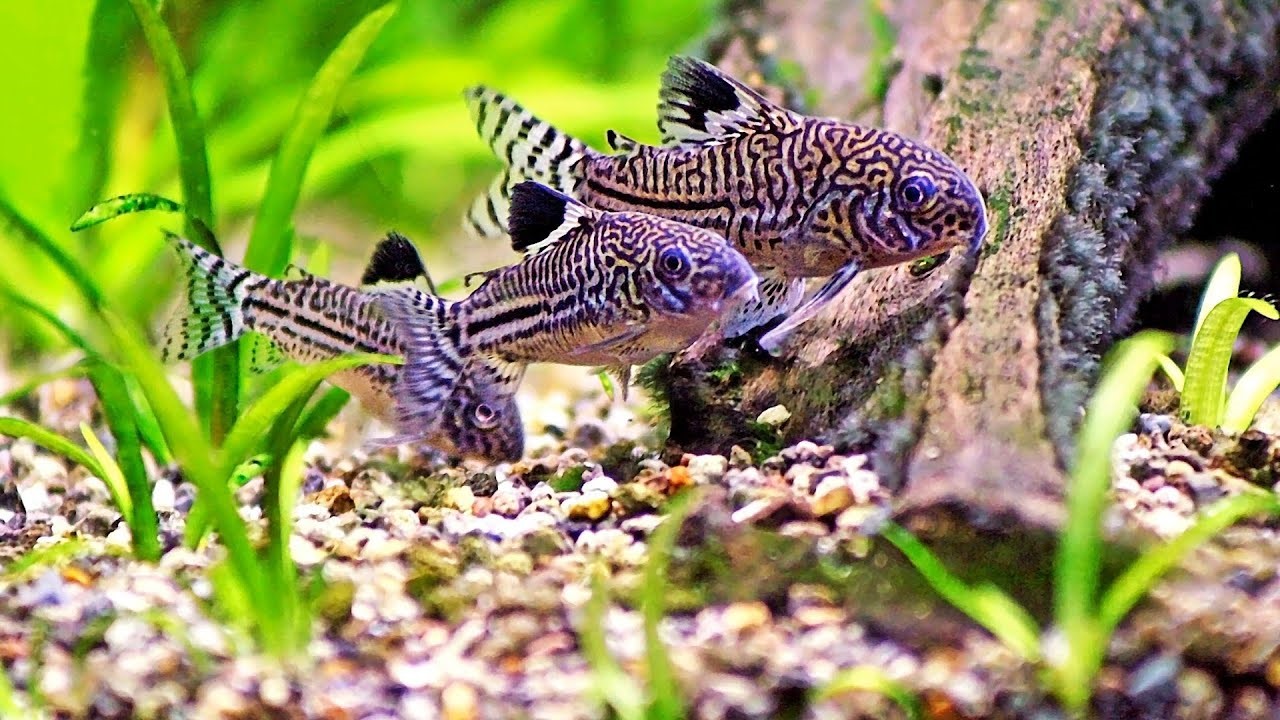
To keep the tank clean, you can use a biological filter that will help you keep the water free of debris. You can also add a special fish that are bottom feeders and keep the tank clean. An example of this type of fish it’s plecos or cory cats, that survive in cold water and can be added to your goldfish tank.

What do you feed a goldfish?

Goldfish can be fed two times per day with presoaked food. You can get a plastic cup with aquarium water, and swirl the food in it before you give it to your goldfish. But let’s see what you can feed your goldfish. Exists on the market special formulated food for goldfish that has a lower concentration of protein and more carbohydrates than normal fish food. They need less protein because they have trouble digesting a higher amount of protein. You can choose pellets or flake forms or both if you want to give your goldfish variety.

How long goldfishes live?

The average life span is between 5-10 years. You can prolong the life of your goldfish by taking the right care for it and the tank environment.

Can goldfish live with other fishes?

Goldfish are social, and they love the presence of other fish in their tank. However, not all fish can live with goldfish because every type of fish has different needs. As I mentioned earlier, bottom-feeder fish such as plecos or cory cats can live with goldfish, and as a bonus, it will take care of the cleaning department of the tank.

But they are also other types of fishes that can live with the goldfish: white cloud mountains minnows, danios or gold medaka.

Goldfishes make extraordinary pets if you pay attention to their low-maintenance needs. It’s a pleasure to have a tank in your house and relax, watching the colorful goldfishes activity in the tank.

Author Bio

Since he was ten years, Tim, writer at SMK Blog (sellingmykidney.com), enjoy fishkeeping. He starts with a 10-gallon tank with betta fish before he moves to a 100-gallon tank where he keeps his betta with turtle, goldfish and some guppies.

DominoQQ Situs judi online agencuan agen taruhan slot online yang memiliki fiture judi online paling cangih dan juga paling gacor online24jam judi bola