 Emma Thompson
Author Archives: Emma Thompson
Hi, I'm Emma Thompson. Welcome to The Pet Town! I'm a Pet lovers like you and please feel free to get in touch with any questions. Enjoy your stay!
 Emma Thompson
Author Archives: Emma Thompson
Hi, I'm Emma Thompson. Welcome to The Pet Town! I'm a Pet lovers like you and please feel free to get in touch with any questions. Enjoy your stay!
Buying toys for a puppy is common but you can’t do it unless you know what to buy. There are plenty of options when it comes to buying toys for puppies. Yet you can still make a mistake when shopping for puppy toys.
Even though the aftermath of such a mistake is not as alarming. This article will help you make better decisions starting today. You can make better toy purchases too for your new puppy. And choose the right toy that won’t harm or cause discomfort to your dog.
One of the major reasons why you buy a toy for a puppy is teething. Allow me to explain.

You buy puppy teething toys when you want your puppy to have fun. But at the same time, you want him to have healthy gums and teeth. This is very important because puppies start to teeth at around 4 months.
As a result, they’ll start to chew on anything and everything. It’s your responsibility to decide what your puppy can chew on. And yes, there is a right and wrong answer here.
If your puppy chews something too big for his size or something too hard. It can cause soreness, bleeding gum, and other problems. If you want your dog to feel no pain or discomfort – decide based on size and softness.

Different dog breeds need different sized toys. You can’t expect a Beagle puppy to play with the same toy as a Golden Retriever puppy. Beagles are smaller than Golden Retrievers primarily by the size of their mouth when they’re puppies.
A Golden Retriever would instantly swallow a toy that’s small. Meanwhile, for a Beagle puppy, that very same toy is fun and engaging to play with.
So you must consider the size of the toy before buying one for your puppy.
A common toy that a puppy should have is a bouncy ball. If the ball is too small for the puppy, he can swallow it accidentally which could lead to a choking hazard. If the ball is too big, he will get discouraged or afraid and not play with the ball at all.
You can have different colors and shapes of balls for your puppy to play with. He can chase the ball around the house, you could teach him how to play catch, etc.

Most toys for puppies come with different shapes and textures. They not only satisfy your puppy’s need to chew down on something. But they keep him occupied as he’s trying to lick or bite every gap or crevice on the toy.
But this is only possible when the toy is slightly hard. Extremely soft toys can be dangerous for puppies. They may figure out a way to chew and swallow them without you noticing that it’s gone.
Hard toys are perfect for puppies because they’re more stimulating. Perhaps not as hard as a tennis ball but slightly spongy. Chew toys, rope toys, and stuffed toys are perfect choices.

It makes sense to say that you can never have enough toys for a puppy. One of the biggest mistakes you can make as a new puppy parent is to not have plenty of toys. Toys are very stimulating in that they keep your dog entertained and happy.
Here are the different kinds of toys you can buy for a puppy. You can consider buying one of each or a few more if your puppy isn’t satisfied with these.
These are the most favorite picks for puppies. And it’s an instant hit with adult dogs too. You can buy a slightly plush ball for a teething puppy. Such balls are not made of plastic so they’re safe and effective to use.
These chew toys with dental cleaning grooves which are perfect for puppies. It keeps them busy, doesn’t make any harsh noise, and is ideal for teething.
There are plenty of different-sized rope toys for puppies. Made up of natural cotton fibers, they stay clean and durable. You can buy them in vibrant colors to attract your dog.
Ropy toys are better for teething than plastic ones. If your dog has sensitive gums, even rubber balls may not be the best option. Rope toys are effective because no matter how many times your puppy bites into the fabric. The rope material stays put and makes for an exciting tug of war!
Do not buy toys for children for your puppy. Such toys usually come with a soft filling that your dog can easily swallow. Puppy toys are made of soft faux fur and seams. Your puppy won’t be able to tear through the fabric. And so chewing on the cuddly and soft toy is not a bad thing.
You can buy stuffed animals that make noise that encourage your puppy to hunt. Squeaker toys, as they are called, are better and more fun to play with.
Treat dispensing toys are more interactive. They will keep your dog’s attention stimulated. And your dog gets automatically awarded by the toy itself for a good well done!
You can buy an adjustable, puppy-friendly treat-dispensing toy. It consists of a large chamber that holds the treats. And as your puppy sniffs and pushes the toy around, small portions of the treat fall out of the toy.
It allows you to store treats and chewy kibbles inside. Your puppy can spend hours trying to get small treats out of this toy.
Puzzle toys are stimulating and challenging, at the same time. They keep your puppy engaged and far away from boredom. They’re as interactive as you want them to be. You can purchase board games or even electronic puzzles toys for your puppy.
Such toys enhance your puppy’s natural instincts. Such as smell, sight, and even taste. They’re reward-based puzzle toys that make your dog smarter and sharper.
Toy obsession with puppies is not such a bad thing. It’s a great mental and physical activity for a dog. Keeps him engaged, stimulated, and active. And toys make great tools for puppy training as well.
If you give your puppy a toy for good behavior. He is more likely to respond to your commands in a gentle and loving manner. Toys can have many benefits. They’re not just fun and games for your puppy.
If you’re still unsure about what toys are best for your specific dog breed, you can also check out our friends over at heelboyheel.com, they have an array of great articles on toys of all shapes, sizes, and toughness!
You can keep your puppy distracted and happy rather than leashed when guests come over. If you work from home, toys are a blessing! And they’re ideal for your dog’s mental and physical development.
For humans, 18 years of age is the stepping stone to adulthood. But that’s not the same with cats, dogs, and all other animals of course. How old is an adult cat? The answer to this is often a confusing topic of discussion among pet owners. Whatever the case, there is one correct answer. Because cat years, like human years, are unchanging and not at all subjective.
It’s only natural to want to know when your feline has grown and matured fully. More often than not, the question arises because you want to make the switch from kitten food to adult cat food.
Even though cat years are unchanging and fixed, there’s no particular age where your little creature stops maturing and growing. Meaning there’s no such definitive age. But then there are general or common age ranges in terms of a cat growing and reaching adulthood.
That said, here’s the information you might be looking for…

The initial six months of a cat’s life is all about kittenhood. This is when adorable little kitties undergo both mental and physical development. And it’s during this stage that their ears and eyes open after birth. To be more specific, it happens when they’re 2-3 weeks old.
Similar to human infants, kittens are exposed to smells, sounds, and sights. So every time an object, person, or another animal comes close, they help in forming the personality of the kitten. Speaking of which, socialization skills are also developed during this phase. As a result of such exposures and interactions.
When the kitten turns 2-3 months old, she starts to detach herself from the mother. And tends to get more curious and independent. That means chewing on things she shouldn’t be chewing. And causing trouble she shouldn’t be causing. The chewing part and playfulness, no doubt, are only common. The former continues until adult teeth begin to grow.
Talking about growth, physical growth happens pretty quickly during kittenhood. A 6-month-old kitten, after all, is the feline version of a 10-year-old human.
Vaccinations are also necessary during this time. And it’s around the same time that kittens are neutered or spayed.

As I mentioned earlier, a kitten that’s 6 months old has already hit the double-digit age in human years. Once your kitten turns 1 year old, she has reached her adult size. Along with her adult habits, preferences, and the like.
A year-old feline, psychologically speaking, is 15 years old in human years. That means a cat that’s 2 years old has reached a state of mental maturity of a human that’s 24 years old.
During this stage, dental cleanings, regular check-ups, and occasional grooming are necessary. They ensure that your cat lives a long, happy, and healthy life.

Not yet a senior cat, a prime adult cat is between the age of 3 years and 6 years. In terms of health, there are no concerns to deal with. Unless your feline has congenital or chronic health conditions that demand medical attention.
Prime cats benefit a great deal from supplements that promote joint health. These keep the knees and hips in good condition. I can’t stress enough that annual check-ups and regular vaccinations are mandatory during this stage.
As for cat age in humans years, a 5-year-old feline is like an adult human in his/her mid-30s.

Did you know that felines typically reach their late teens? And that’s why a cat between the age of 7 and 10 years isn’t labeled as senior yet. Meaning their retirement age has not been reached so far. Nevertheless, an aging cat demands proper nutrition. Mainly because obesity during this stage is very common among felines.
It’s during this particular period as well that you should keep a close check for dental diseases and kidney problems. Therefore, regular or annual blood tests are essential. Just to make sure all the organs are functioning properly.

Senior cats are those that have passed the 11-year mark. One of the most common health conditions during this time is associated with the joints. Even the functioning of organs in the body starts to deteriorate. And that means a more vigilant check on bloodwork and vet visits.
During the senior years, dietary changes are also highly recommended. Because olders cats have different nutritional needs as their bodies are changing.
If your feline, after the age of 11, becomes a little crabby. Then chances are likely that he’s experiencing some form of joint pain or discomfort. Confusion and brain changes are also a common occurrence among senior cats.
The best thing to do is to speak to your vet. Allow him/her to observe changes in your cat’s blood work and overall health.

How long do cats live? Some of them reach the mark of 100 in human years. That means 20 in cat years. Because a 15-year-old feline is like a human in his/her mid-70s. So cats above the age of 15 are categorized as geriatric. And they require professional vet attention once in every 6 months.
No doubt, geriatric cats should be fed special or medicated foods as well as supplements. After all, the bodily systems, at this point, demand special support and care. What’s common among geriatric felines is poor vision and hearing abilities. And it’s only common for them to sleep for the most part of the day.
A decline of cognitive capacities is also typical. Much like humans after the age of 90. Cognitive dysfunction includes defecating or urinating anywhere, crying at night, and other such unusual behavior.
How old is an adult cat? How old is my cat in human years? Along with cat behavior by age. I have discussed everything you might need to know about the age of cats. A year of a cat is equal to 7 human years.
On top of that, felines also age faster in comparison to humans. And with age comes the onset of medical and health concerns.
The aging-related illness you cannot avoid. But you certainly can make your adorable little creature feel comfortable. Simply by doing your part. And by that, I mean taking care of her nutrition and following regular vet visits.
Does your dog love rolling around in the mud and smelly things? Is one of those smelly things his poop? While this can be alarming for pet owners, there’s no fixed reason why dogs do this.
However, there are a few theories that I will be telling you about today. These all briefly explain why your dog could be rolling in poop. And they also explain how you can stop a dog from rolling in poop. The solution is in the problem itself.
Did you know that dogs dislike smelling fresh and clean? All those dog shampoos that contain natural scents are not at all charming for a dog. So when you give them a bath, all dogs want is to roll around in “earthy” things. This is to get that scent of perfume off of them.
This means that whenever your dog gets a chance. He will plunge into things that smell dirty including the garbage, shoes, feces, and muddy surfaces.
Another common reason why dogs roll in poop is by instinct. Dog’s ancestors used to mark their boundaries by their scent. And one of the ways they did that was my smelling of their feces. Such territorial markings are still common in cats.
I know this much is true because I have cats that have peed to map their territories around the house. Especially when you move into a new home or have guests over for a while.
Dogs do that same to mask their natural scent. Another reason is that dog’s ancestors used to hunt better by masking their dog scent. So by covering themselves in animal feces, the hunted could be easily tricked and killed.

Now that you know that this isn’t a behavioral issue. You can put a stop to this gently and compassionately. It’s like training your puppy to sit or stand or paw your hand. It’s a process that could potentially bring you and your dog closer.
Punishing your dog for rolling around in poop is a bad idea. It can cause stress and anxiety in your dog. And your dog might not end up listening to you but he may get scared of you which time he poops. This can have other consequences such as constipation and loss of appetite.
There is a subtle and dog-friendly way to go about this.

Don’t give your dog a chance to roll in poop. When you take your dog out for a walk, keep him on a shorter leash. And as soon as he’s done pooping, use a scooper and a plastic bag to discard the poop immediately.
Pet your dog and reward him with a treat whenever he does this. So he knows that not rolling in poop gives me a treat. Do this a few times in a week or whenever you take him out for a walk.
If you have a backyard, you can make this a daily activity. Always keep your dog on a leash.
As soon as your dog poops, allow him to sniff it which dogs usually do or dig the area around his poop so as to cover it. Then pick up the poop with a scoop and throw it away.
Your dog is most likely to be around you when you do that. So give him a treat for his good behavior and allow him to run freely around the yard.
With the ‘Leave It’ command, your dog can stop eating food he’s not supposed to eat. You can stop chewing your shoes, your bra, and your pillow to shreds. Lastly, he can also stop rolling around in poop.
The best and most effective way to teach your dog to Leave It is with treats. Break the treats into pea-sized pieces. And hold a few broken pieces in the palm of your eyes. They must be away from your dog’s eyesight. But he should be able to smell it.
Make sure that while training your dog you do so in a quiet space. Distractions or loud noises will only break your dog’s focus.
The ‘Leave It’ command can also be a great option for poop diving. This is when your dog is rolling around in the grass – more specifically in the area where he’s going to poop. This is common if your dog is used to pooping in the same spot every day.
You can also train your dog to Leave It right before he’s about to start rolling around. You can carry a few delicious treats along with you. Every time your dog seems about to dive into the poop or play with. Make a clicker sound to catch your dog’s attention.
Mostly likely that by this time, your dog will have smelt food on you. As soon as your dog has your attention and stays away from the poop. You feed him a piece with your other hand. Verbal cues such as “yes!” or “good boy!” are perfect. Your dog will respond to such praise and eventually back away after pooping.
Next time you find your dog running to you covered in the brown stuff. You must take a closer look and see what that brown stuff is. Is it mud? Or is it his poop? Dogs love rolling around in poop for a bunch of reasons. But bathing your dog each time he does that is not at all practical.
But with the help of this article, you can put an end to that right away. It’s not a quick fix but with proper training, you can stop your dog from rolling in poop. Such behavior can easily be fixed with the Leave It command or by proper hygiene.
Trust me; if you follow these steps you’ll be saving yourself a lot of trouble. A simple Leave It training command can solve most of your issues. Whether your dog is eating out of the garbage, spoiling your couch pillows, or gabbing socks from the laundry.
If you’re bringing a new Box Turtle home, it’s difficult to tell its age. For people who don’t know much about Box Turtles, or any Turtles, this is nearly impossible! So what do you do?
You read an article about how to tell the age of a box turtle. And then you finally know the correct age of figuring out a box turtle’s age. This method is quite simple really. You can do various things to tell the age of a box turtle.
From counting its rings, checking its size, and comparing it with other turtles. There is, in fact, a size chart that you can also refer to for this. Determining the age of a box turtle can also depend on its gender.
Know more about this and how to tell the age of a box turtle.

A turtle’s shell has scutes that grow with age. Scutes are bony plates or scales that cover the shell of a turtle. Having said that, they don’t just increase in number because of age.
Scutes on a turtle’s body can grow because of hunger or even sickness. Interchangeably, they can also grow after having lots of food. It also affects the time of the year – which means in the winter and summer months.
Counting rings to determine the age of a box turtle is not foolproof. However, this gives you a rough estimate of how young/old a box turtle can be.
When you’re counting the rings, avoid counting the scutes. You have to look for rings within the scutes as that gives you a better estimate of their age.
For example, there are two types of rings within a scute. The first is wider rings that indicate a turtle’s good eating days. And the second is narrower rings that indicate a turtle’s scarce eating days. Both fit into the seasonal changes of summer and winter climates respectively.
Tallying Up the Numbers
Once you have an estimate of the number of rings on a turtle’s shell. Let’s assume it’s 14 rings in total. You’re supposed to subtract that by 2 considering the divide between wide and narrow rings. That should give you a likely age of 7 years.
Every 2 rings on a turtle’s shell, within the scutes, represents 1 passing year. So for 14 rings, your box turtle is likely to be 7 years old.

A box turtle’s size can point out the age of the box turtle easily. It’s easier to figure out the age of a younger turtle by size than it is for an older turtle.
Measure the tip of the turtle’s tail to the top. This should give you a good estimate of how big the box turtle is. The best way to do this is to get an idea of the general turtle sizes of the species.
This should help you compare and figure out the age of a box turtle. Researching other species’ age and size, for instance, can have a huge impact.
The largest a common Southern Painted Turtle can grow is up to 6 inches. And a Western Painted Turtle can grow up to 7 inches.
It’s a known fact that turtles as pets can grow faster than those in the wild. However, this is not indicative of the turtle’s age in any way.
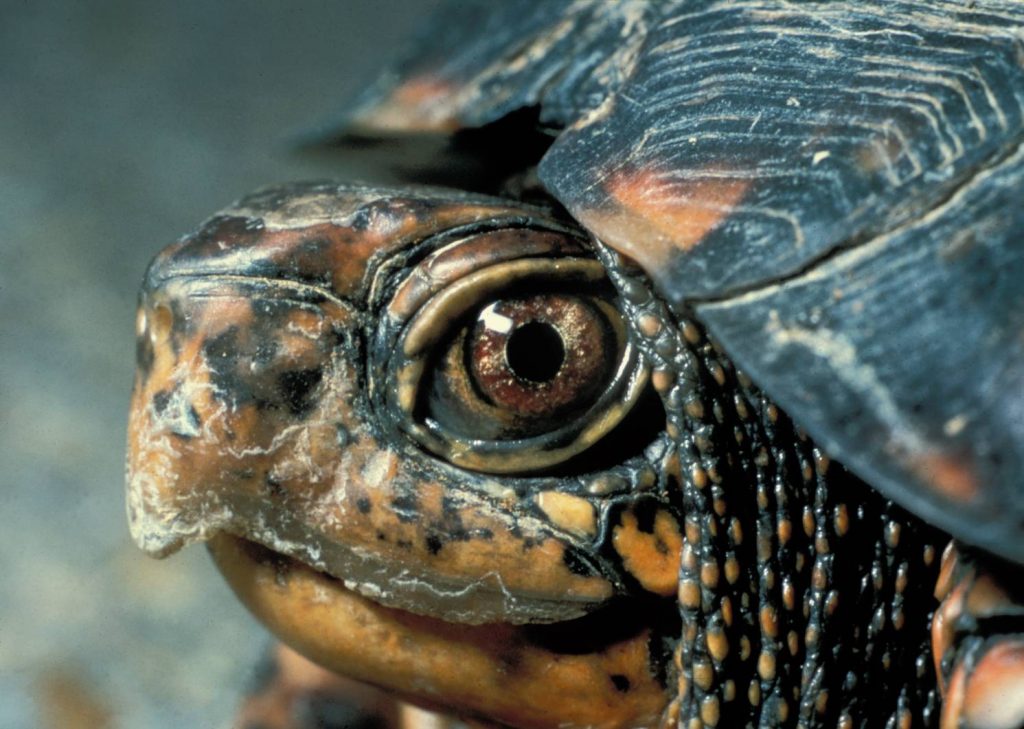
If you want to determine aging in an adult turtle, the behavior is a good cue as well. You can examine the turtle’s shell for signs of discoloration and texture. Wild turtles have scars and dents in their shell which determines wear and tear.
These signs may not indicate age per se. But by the number of dents and scrapes, you can make out between an old and a young box turtle.
Turtle shells also darken as they get older. Younger box turtles have fresh patterning on their shells. This distinction between young and old turtles is noticeable right away. It won’t point out the exact age of the turtle. But it’s enough to give you a clear idea of how old or young the turtle is.
A box turtle’s shell is remarkably strong. But it is still prone to scars, dents, and other wear and tear. This is most likely by being in the wild. This is one of the major reasons why box turtles in captivity live for longer than turtles in the wild.
This keeps them away from serious injuries and other contagious diseases.
Malnutrition and other metabolic irregularities may also cause shell diseases. Common shell disease is Irregular Shell Growth. This is brought on by a lack of proper nutrition and metabolic diseases.
In this case, a large shell does not indicate older age. If you do notice this though, you must address the underlying problem of the box turtle immediately. This means checking for mineral and vitamin deficiencies.
Too much light or a stressful environment may cause such distress in box turtles. Consult with a vet to know the correct treatment for such irregular shell growth.
Lastly, Salmonella in children is caused by coming into contact with wild animals. Turtles are among them only if they, too, are infected with Salmonella. You might not see signs of Salmonella in turtles as they’re usually asymptomatic.
But this condition passes through feces. It may cause nausea, vomiting, diarrhea, and other gastrointestinal symptoms in humans.
Going to the vet should be enough to determine the age of a box turtle. In general, female turtles are bigger in size than males. And you can differentiate a young and old turtle by the color and texture and shape of the shell.
Having said that, if you want to satisfy your curiosity, this article should help you. You can determine a rough estimate with the help of the steps mentioned in this article. The age, size, and species are easier to determine and compare. All you need is a measuring tape and a turtle size chart to fall back on.
Betta fish is one of the most graceful and exotic fish out there. The betta has glorious fins and vibrant colors that make it different from every other fish. Besides, it is a good option if you’re thinking of petting a fish.
However, if you intend to keep a betta in your home then it really deserves good care and a lovely comfy home.
Well, this article will walk you through how you can set up a tank for your Betta fish and how to give your charming fish a nice home.
It might sound easy but setting up a tank isn’t an easy task, rather it is a mission that requires planning and solid execution. There are certain things – such as choosing a proper tank with a filter and a heater, choosing a right place for it, decorating it up – that you need and have to do in order to keep your betta fish cheerful and relaxed in its new home.
However, before buying an aquarium tank for your betta fish, we would recommend that you go through betta tank reviews which would help you shortlist tanks for your betta fish and make the best choice.

As a new aquarist, you should buy the tank and set it before you bring your new pet home. Besides, it’s important that the size of your tank goes with the size of your betta fish. Otherwise, a closed confined space will only make your betta uncomfortable and sick. Plus, we don’t want that, do we?
It is true that the betta fish is usually found in shallow water, but that doesn’t mean they are keen on living in a closed space. It would be best that you purchase a large tank, perhaps a 5 to 10-gallon tank would be great. Moreover, you can also go for a larger tank – the bigger the tank the better it is.
The large tank ensures an easy formation of the nitrogen cycle owing to the low volume of water. Certainly, it will keep your betta happy and comfortable. However, smaller tanks can also formulate a nitrogen cycle, but it takes longer to form.
We would recommend that you go through betta tank reviews, that would help you shortlist tanks for your betta fish and make a better choice.
Bettas’ long, streaming balances make it hard for them to swim in solid ebbs and flows. So you’ll have to buy a ‘delicate’ filter. Even though bettas originate from still waters, you still would need a filter for your tank.
A filter will help keep your tank clean and it will reduce the probability of bacteria growing in your tank and causing disease. Moreover, it is advised that if you purchase a filter, it has a greater GPH (Gallons per hour) than the tank – it will ensure that clean water is always available for your betta.
You might not have known this, but you also need a heater for a fish tank because, in the event that the temperature drops excessively low, it will give a gateway to infections and bacteria. But it shouldn’t be too high as well, otherwise, it’s going to accelerate your betta’s ageing process.
Pick a heater that allows you to regulate the temperature, so it’s easy to control the temperature. Moreover, you should purchase a submarine radiator which can keep the temperature between 78-80 degrees Fahrenheit.
Furthermore, you’d like to have the option to effortlessly monitor the temperature. Therefore, take a look at available options and choose the one that suits your needs.

Consider setting up a source of light for your betta fish. As it sleeps in the dark and wakes up when it’s light. Hence, set up lights whose intensity you can control to allow your betta to make its own schedule.
It might come as a surprise but gravels tend to play a very important part in maintaining the ecosystem of the tank. It tends to break down waste and allows useful bacteria to grow.
However, bettas swim at all levels, and it’s regular for a betta to swim along the base. Therefore, you should purchase little or smooth rocks so your betta doesn’t hurt itself.

Your betta will definitely love swimming in a tank that contains caverns to cover up in and plants to lay low in. Your betta will definitely enjoy relaxing on leaves and caverns. However, live plants are, in every case, great since they’ll keep the water fresh and clean and furnish your betta with a natural environment.
Don’t use plastic or silk decorations in the tank otherwise, it might just end up cutting or damaging its delicate fins or skin. Keep your tank clean and decorated, otherwise, it will bore your betta fish.
Just make sure the aquarium is well placed and has all the factors that have been mentioned above. Once you have set it all up just fill it up with water and you have made a home for your Siamese fighting fish.
Let your betta fish swim around and get cozy in its new home. Hopefully, this article proves helpful for you and aids in creating a clean, pleasing home for your new fellow.
A well-behaved adult dog knows that humans are in charge and are willing to listen to any given command despite distractions from their environment. In order to maintain control of your adult dog it’s important that you spend time training them using positive reinforcement and rewards for listening. It’s also important to maintain discipline and stick to your training routine and commands.
If you reward your adult dog for not listening, then they will not always listen to the command. There are plenty of constructive ways to control your dog without harming them. We will review some of the best tips to control your adult dog. For more information about dog training and dog related products, visit Care of My Dog.

You need to explain to your dog that you are the owner and the best way to do this is with positive rewards. The owner will decide whether or not the dog gets the treat. This gives you leverage and control over your dog if they are food motivated. If your dog is not food motivated, try using their favorite dog toys or other high-value rewards.
Some dogs simply respond to encouraging non-food rewards, such as toys, a stomach rub, a walk, or positive words like “Good boy / girl”. You must know what’s best for your adult dog in order to get them to listen to your commands.
You need to make your dog think that you are the boss. Thus, you need to be sure that the dog knows they can’t take advantage of you in any given situation. Any human actions can lead a dog to think that they don’t have to listen to you. Some examples of maintaining control over your dog is to make the dog wait for their food at dinner. When your dog waits for their food, they understand that you are the one in control.
Many different dogs will beg or whine or even bark. However, it’s important that you maintain control over your dog in all situations or they won’t feel compelled to ever listen to you. Make sure that you are always in control in any given situation.
Making sure you have full control over your adult dog means that you will have to frequently train them. Typically, this involved constant correction if your dog is climbing on your couches, scratching, or barking. One of the best ways to correct impulsive dog behavior is to put your dog in “time out” which can be either in the bathroom of their crate. This needs to happen immediately after they do something they aren’t supposed to do.
In addition, it’s typically a good idea to enroll your dog in dog training classes to learn commands. Teaching your dog sit, down, stay, wait, and other basic commands lets them know that you are in control. This also helps when your dog is out in public and you need them to behave well.
You never ever want to encourage bad behavior or reward bad behavior. This will ruin all your dog’s previous training and they will get confused if you punish them later down the line. One of the most common mistakes that down owners make is letting a dog sleep in your bed and then later telling them to sleep at their respective place. If you don’t want your dog to sleep in your bed, you should not allow your dog to sleep inside your bed ever.
It’s important to make sure that you assign your dog a place to sleep so they know that you are in control of the situation. This could be their dog bed, a crate, or the couch. However, you need to create a routine for your dog and not allow bad behavior over and over again. Always be consistent in your training!
Increasing the sound of your voice when you are frustrated in training will let your dog know that they need to listen. In addition to increasing your voice, make eye contact with them to let them know that they aren’t obeying what you are saying.
In addition, increasing the sound of your voice helps dogs pick up on certain words or commands so they will listen to you.
Dogs are typically very smart and respond well to owners who are in control. Ultimately, you need to figure out what your dog likes and how you can gain leverage over the things they want. Some dogs like the Shiba Inu are going to be toy or voice motivated. Other dogs like the Goldendoodle or Labrador are going to be food motivated. For more information about dogs, you can always visit We Love Doodles. Good luck training your dog and always remember to be in control!
Cleaning your cat’s litter box on a daily basis can become a hassle, and there may be some days where you do not feel like cleaning it at all. The stench alone can repel you from the litter box, but it is the terrible things that are hidden behind the smell that you really need to be concerned about.
Dirty litter boxes can become a breeding ground for many different forms of bacteria and parasites. This can become dangerous if you do not keep up a regular cleaning schedule, as Brentmore Labs warns. These are just a few ways explaining how your health and the health of others could be impacted by a dirty litter box.
Dirty litter boxes can affect humans and cats equally, and they both are at high risk of contracting diseases from litter boxes. There is an astounding amount of diseases that humans can be exposed to through their cat’s waste that can affect their physical and mental health alike. You may need to contact your doctor if you believe you have contracted some form of sickness because of your cat’s litter box.
Cat’s urine has ammonia in it, and an overexposure to ammonia can cause you to have serious breathing problems or headaches, and you can even end up catching pneumonia. Ammonia is a toxic gas that can irritate and even damage your lungs.
Other ammonia related symptoms include lightheadedness, minor headaches, and irritation to your lungs. Your cat may also be prone to being affected by the buildup of ammonia in their litter box, so make sure you see your doctor and take your cat to the vet if either of you start to feel sick.
Toxoplasmosis is a disease that is transmittable to humans through their cat’s urine and waste, caused by a parasite known as Toxoplasma gondii. T. gondii has been proven to cause behavioral changes and illness through exposure and can stay within the human body for an indeterminable amount of time.
It could even go so far as to affect your cognitive functions and wear down your memory, even if you have never had any similar memory or cognitive issues prior to being exposed. You will be even more at risk of contracting this disease if you have a compromised central nervous system.
Cat scratch disease happens as a result of being exposed to a cat or litter box that has been infected with Bartonella henselae bacteria. Cat scratch disease can easily affect people who are immunocompromised, and can become a severe condition for them to suffer with.
Cats can become infected with Bartonella henselae bacteria through infected parasites such as fleas and ticks, regardless of whether they are outdoor or indoor cats. They are highly common amongst outdoor cats and symptoms in humans appear as loss of appetite, body aches, headaches, fatigue, and so much more.

All of the aforementioned diseases and bacteria can affect cats as well, but other dire health risks to look out for include urinary tract infections or kidney issues. Cats will usually not approach or use their litter box until it has been thoroughly cleaned, opting to hold their waste in instead. This can lead to negative impacts on your cat’s kidney and bladder health over an extended period of time.
Your cat could contract a urinary tract infection, which will cause them an immense amount of discomfort and also may make them continue to avoid using the litter box. The cost of treating a UTI in your cat will also be quite heavy. It is important to take them to the vet if they show signs of having a UTI and clean the litter box regularly in order to help avoid it from happening altogether.

Cleaning your cat’s litter box regularly will not only prevent you and your cat from being exposed to bacteria, but it will also encourage your cat to continue using it properly and reduce the strength of the odors emanating from the litter box. It can become a gruesome chore over time, but it needs to be done properly in order to keep you and your cat healthy and happy in your environment. Following a regular cleaning schedule and protecting yourself from the bacteria that may be residing in the litter box will help lower the chances of contracting illnesses.
You will want to keep a litter scooper, cleaning supplies, face masks, garbage bags and gloves around you whenever you begin cleaning your cat’s litter box. You may have different cleaning schedules depending on the type of cat litter you use, but make sure to keep the schedule consistent.

Keeping your cat’s litter box clean is a big part of being a cat owner. Keep yourself and your cat happy and healthy by preventing the accumulation of bacteria in your cat’s litter box.
As COVID-19 continues to change people’s lives, pets are also affected. Because of restrictions in movement, pet owners are no longer able to walk their pets. In some places, it is impossible even to visit your vet because of such restrictions.
Therefore, as expected, the pets are undergoing stressing changes in their lives. However, as a pet owner, you can make use of CBD to help your pets adapt to the new normal. Pets are important to us especially now that we spend most of our time in our homes.
Using CBD can help your pet be more comfortable in situations that induce stress. While more and more pet owners are starting to realize the benefits of giving pets CBD, there is still a lot of confusion on how CBD helps pets, the dosage that one should use, or is CBD worth your money even when there are many CBD brands offering sweets deals for their products.
CBD is a chemical that is extracted from hemp. It is famous because it gives a state of being calm and helps the inflammatory system. It is vital to note that all CBD products should have no more than 3% of THC.
There are many ways CBD benefits pets. For instance, there are many products out there that help pets whenever the time comes for the pets to visit the vet. It is worth noting that long car rides, old age, and even grooming the pets puts them in a whole world of discomfort.
CBD products help pets to relax and also encourage normal recovery after visiting the vet. Research has also shown that CBD products help pets to enjoy a nice and relaxing night’s sleep while at the same time improving the digestion process.
Other ways that CBD products benefit pets include enhancing the mental and physical well-being of pets, helps pets that show hyperactivity or nervousness, provides nutrients for pets which have started to age, CBD is also known to promote long term health or pets, and it also helps the pets to remain calm.
The amount of dosage that you should give your pet matters because you do not want to give your pet an overdose. One of the main ways you can use to determine the dosage to give your pet is by using the pet’s size and weight to estimate the dosage. The CBD product which you are using also determines the dosage to give to the pet.
After you have administered the CBD to the pet, you should carefully examine the pet so that you can note the changes in the pet’s mood and its temperament. Observation will help you adjust the dosage until you come up with the best dosage for your pet.
There are also places where you can get the dosage that you should administer to your pet. In most cases, businesses that sell CBD products can guide you on the right dose to offer to your pet.
There are many CBD products out there that you can give your pets including CBD pet chews and CBD pet oil. However, how do you determine which CBD product to use? First of all, you should remember that you know your pet better than anyone. So you are the one who should make the final decision on which type of CBD product to buy for your pet.
To make the process of administering CBD easy, you can decide to go for CBD oil because you will only need to squeeze the oil drops onto the pet’s food. You can also administer the product by directly squeezing the CBD oil into the pet’s mouth or ear. You should ensure that you read the instructions before you administer the product. Also, make sure to make all the necessary inquiries if you are not sure about the CBD product.
The most common CBD products are treats and oil. You can administer treats by crushing the CBD product and adding it to the pet’s food. As mentioned earlier, oils can be administered through squeezing as few drops on the pet’s food, squeezing the oil onto the pet’s mouth, or rubbing the oil on places where the pet has injuries or itching paws.
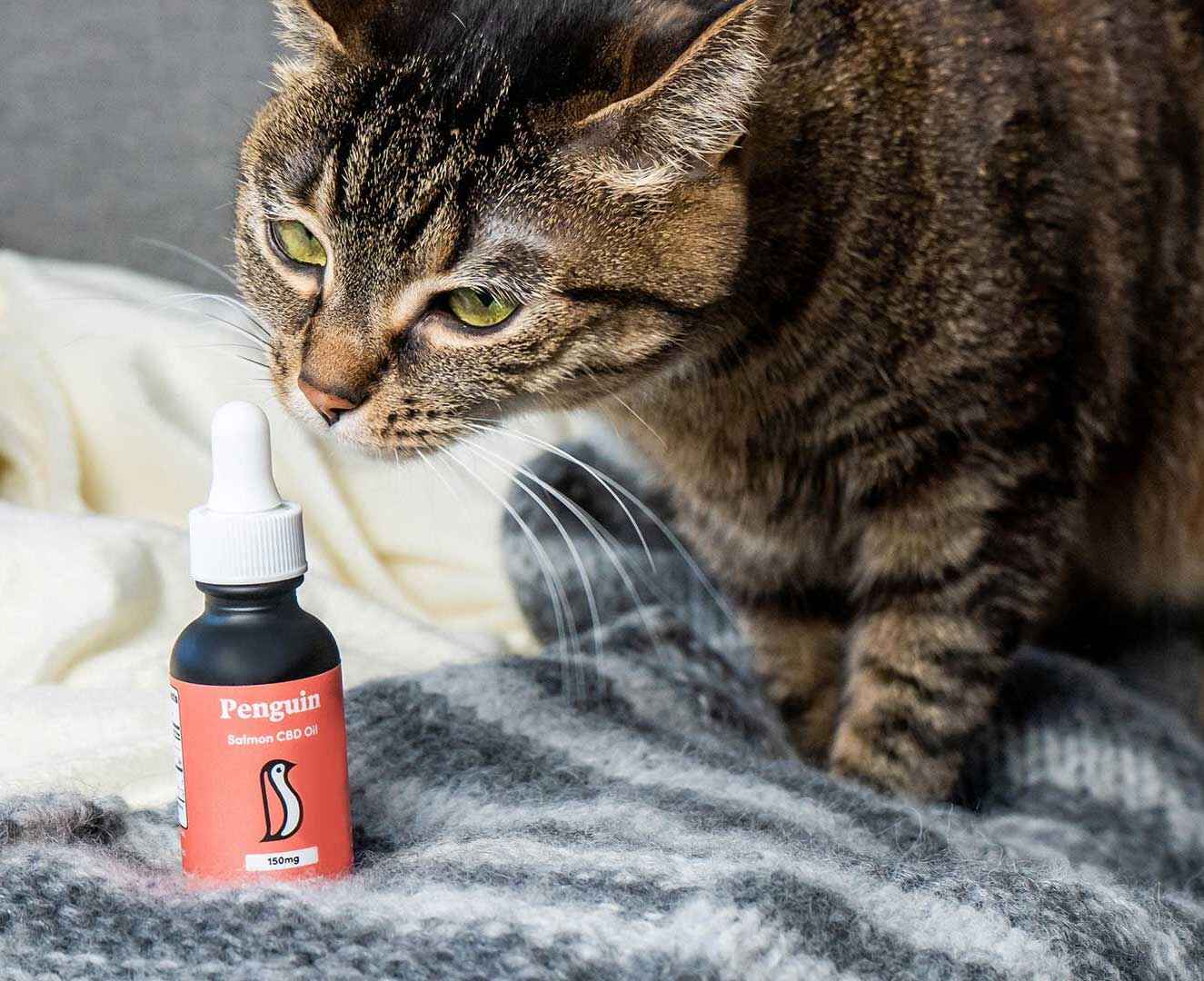 Long term benefits of CBD on Pets
Depending on the dosage that you offer your pet, you can notice the results immediately or within the first few hours of administering CBD. However, in some cases, the results can take at least 3 – 7 days. As the pet adapts to the CBD, then you can start increasing the dose slowly until you are satisfied with the results.
You should know that as much as our lives have changed drastically due to the COVID-19 pandemic, the pets have also been affected. For instance, people are not able to walk their dogs like they used to before the pandemic hit. Therefore, it is advisable to use CBD to help your pet deal with the changes that have come along. If you follow the guidelines mentioned here, you can be sure that your pet will adapt to new-normal without any problems.
Giving dogs pills and medicine is truly a tricky task because most dogs don’t like the smell or taste of drugs. Whether you want to give them treatment pills or supplements and vitamins, they’ll most likely try to resist and fight you. Even once they’ve swallowed the tablet or pill, they might end up spitting it out or vomiting it up.

Nonetheless, there are still ways in which you can make your furry baby take his vitamins. Here are 5 tips to help your dog to take his vitamin:
If your dog is resisting due to not liking the taste, smell and size of the vitamins, there’s something you can do to remedy the situation. You can crush vitamins like Glucosamine for dogs into powder and sprinkle or mix with the food.
Ideally, you should mix the powdered pill with pasty or moist food. This is because your dog can easily notice the vitamin powder in dry dog foods. If your dog’s regular meal is dry, you should moisten the dry food first to add the vitamin powder evenly and invisibly into the food.
You should ensure that the powder is thoroughly mixed with the food so that it won’t be visible to the dog. Dogs are highly sensitive so, if you don’t play this trick right, your pet might end up rejecting the meal with the vitamin in it.
You should try to mix only a minimal quantity of the powder into the meal. This is so the vitamin’s smell and taste doesn’t overpower the dog food’s. You can then continue to add the powdered vitamin from time to time when you give your dog food.
If your dog doesn’t like the taste of solid medicine, you can try a liquid option to get him to take the drug. Instead of mixing the vitamin’s powdered form into your dog food, you can mix the powder into water or dissolve the vitamin in the water.
This liquidized form will be easier to drink compared to the solid form. Besides, it won’t taste or smell repulsive to the dog like the solid form might have. If the dog likes this method, you can incorporate this into his diet and coax him into taking this before he is given food.
Sometimes, vets advise that dogs take vitamins as a whole because they perform faster and more effectively whole than they do powdered or liquidized. To give a vitamin to your dog whole, you can take a chunk of your dog’s food or snack, mold it around the vitamin, and feed it to him. He’ll most likely swallow it along with the vitamin in his excitement to eat the food or treat.
But if he chews on the treat/food with the vitamin in the middle, he could spit it out and never accept that particular treat or meal again. So, you should apply caution when using this method. Also, if a type or brand of vitamin particularly repulses your dog, you might have to consider buying another type. That might just be the lasting solution to make your dog take his vitamins.
Just like you can sweet-talk kids and persuade them to take drugs, you can do the same for dogs. Before you try giving vitamins to your dog, first try to pet him and put him at ease. Make him feel comfortable and happy by playing with him and rubbing his fur. You can then bring forth the vitamins and pretend as though you want to swallow the vitamin.
His inquisitive nature, as well as his desire to eat what you have with you, could make him want to take the vitamin. You could even create a fake competition with him to see who will first gobble up the vitamin. Dogs are naturally competitive, so he’ll most likely rise to the challenge and want to take the pill. It also helps if you offer treats as a reward.
Don’t overlook the place of treats and rewards in getting your dog to take his vitamins. If he sees that you want to offer him treat or food as rewards for gently taking his pills, he’ll love to take them.
At times, no amount of petting or cajoling can make a dog take his pills, particularly if he is stubborn and he really detests the tablet. This means that you might have tried concealing the vitamin in pill food or powdering/liquidizing with no positive result.
At that point, you should give him the vitamins the firm way. First, sit your dog down and hold him firmly so he won’t try to run away. Next, slowly and gently open his mouth.
While doing that, try massaging his muzzle so he can loosen up the mouth. Once that is in place, you should place the pill at the back of his throat and close his mouth. Hold your hand to his mouth and keep it closed for some minutes, so he doesn’t try to spit out the drug. While your hand is covering his mouth, continue to massage and pet him while whispering sweetly.
Try not to manhandle him as that would put a strain on your relationship with him. Your sweet demeanour will put him at ease until the vitamin finds its way down his throat. And you know what? With time, he might feel cool with the pill without you even having to force it down his throat.
Conclusion
Dogs are just like human beings – they don’t like pills and tablets. But, that doesn’t mean they can avoid it. The important thing to do is find a productive trick to use in giving your dog his pills. You can try the tips above before finally settling for one that best suits your dog. And the best part is that once he gets familiar with using his vitamins, he’ll see it as a normal part of his diet and no longer resist the drug.
Our pets feed off of our energy, and that of the world around them. That’s why many dogs, much like humans, can develop stress, anxiety and an intense fear of separation from their owners.
So, while you do your own self-care practices like warm baths, meditation, and online shopping, don’t forget to do pet care practices on your furry friend. There are a number of ways to help alleviate anxiety in pets, from giving them tug-of-war toys to regularly exercising them. One great method is with chewy, long-lasting treats.
Bully sticks are a popular example of these. Not only are they soothing for pets with stress or anxiety, but they’re also thought to be helpful in quelling destructive behavior such as digging and ripping up furniture.
This article will discuss how to choose the right bully sticks for your dog. But first…
Bully sticks are a natural and safe alternative to regular rawhide chews. You also may have heard them called: bull sticks, pizzle sticks, bull pizzles, or steer sticks. They’re fun for your pet to chew because they taste great and they won’t splinter like some other dog treats. You may like to give your pup one bully stick to see if it’s the right choice for them. Even though bully sticks don’t have preservatives, some brands are safe for up to three years.
Remember, bully sticks aren’t a one-size-fits-all treat, so here are a few things to consider when choosing the right ones for your dog.
The most important thing to consider when choosing the right bully sticks for your pet is the size of the stick itself. It’s important you think about the size and strength of your dog when choosing the size of bully stick for them. For instance, if you have a large or giant dog breed, you’ll want to select a bigger and thicker bully stick that’ll be more difficult for your pet to chew through. That will allow your pup more play time with the treat!
If your pet is small or older, try choosing a smaller bully stick that they’ll have no issues getting their jaw at least partially around. If you choose the right size for your dog, your bully stick could last from several hours to a few days.
Bully sticks, like all dog chews, come in a variety of shapes, and while you may think there isn’t any nutritional difference to the shape you choose, it can actually affect how quickly your dog gets through it. Most bully sticks come in thin, regular, and thick widths. For dogs with stronger jaws, try a bully stick that’s braided, curled, or thick. This will make the treat a bit harder for your dog to get their mouth around so it’ll last longer. Further, they may also lower your dog’s risk of choking by chewing on a treat that’s too small, and could get lodged in their throat. If you have a dog with a small or weak jaw, choose a classic thin style.
Ingredients are critical when choosing any treat or food that your pet will consume. Think about the last time you indulged in some super greasy junk food. You probably felt slow, heavy, and lethargic afterwards. Perhaps you felt some digestion problems. Yet, when you eat a clean, nutrient-dense meal full of protein and natural ingredients, you may have felt energized, full but not weighed down, and ready to take on the day. It’s the same for your pet! Making sure their treats have healthy natural ingredients and no dangerous chemicals will benefit their health.
The general rule of thumb when choosing a treat for your pet is: the less ingredients, the better. Typically, dog treats with less ingredients will be lower in calories and higher in protein, making them a nutritious option for your pet to maintain or lose weight. They’re also often very high in nutrients and antioxidants.

Some common ingredients in the best bully sticks include:
Sometimes, man’s best friend can get just as anxious as you can. Along with adequate exercise, and lots of love and attention, giving your pup right bully stick you can help keep them happy, calm, and of course, occupied. When choosing the perfect bully stick for your pet, it’s important to consider size, shape, and ingredients. Always refer to your pet’s veterinarian for health and diet advice before feeding them something new.